Choosing microservices documentation tools is not about finding one application that can document an entire distributed system. It is about deciding where each piece of information belongs, who maintains it, and how developers find the correct version when a service changes.
An API specification, architecture diagram, deployment runbook, and service ownership record do different jobs. Putting all four into a wiki does not automatically make them accurate. Generating all four from code is not realistic either.
A better approach is to establish a source of truth for each type of information, select tools around those responsibilities, and connect the pieces through a repeatable publishing process.
This guide compares the tools by job, explains when to keep documentation inside service repositories, and shows how to build a pipeline that validates and publishes documentation alongside application changes. The central recommendation is straightforward: generate facts that already exist in code or machine-readable contracts, but keep operational explanations and engineering decisions under human ownership.
What microservices documentation must make discoverable
Microservices documentation has two distinct audiences. A developer working on one service needs its implementation details. Someone investigating the wider system needs to understand how services connect and where responsibilities begin and end.
Trying to serve both audiences with one large document creates unnecessary complexity.
Start with a system-level map. It should identify the services, their responsibilities, important dependencies, communication paths, and the direction of significant data flows. A developer should be able to follow a request across services without searching through unrelated implementation details.
Then document each service separately. A service-level page should answer these questions:
- What business or technical responsibility does this service own?
- Which team maintains it, and who handles support?
- Where is its source repository?
- Which services or external systems does it depend on?
- Which HTTP endpoints, events, or messages does it expose and consume?
- Which protocols and authentication mechanisms does it use?
- Where are its deployment instructions, configuration references, and operational runbooks?
Architecture diagrams and written documentation should complement each other. The vFunction guide to documenting microservices makes this distinction clearly: diagrams provide a high-level view of service relationships, dependencies, and workflows, while written documentation explains the individual services.
For example, consider an order-processing system containing an order service, payment service, inventory service, and notification service. The microservices architecture diagram should show the interactions between those components alongside the core microservices architecture components. The order service page should explain its own responsibilities, API contract, dependencies, owner, and operational procedures.
A useful documentation structure therefore has three layers:
- System discovery: What exists, how services relate, and where to find them.
- Service documentation: What each service does, who owns it, and how it operates.
- Technical contracts: The exact interfaces and messages exchanged between components.
This layering mirrors the C4 model (Context, Containers, Components, Code): start from the system context, then work down to the components and their contracts. You don’t have to adopt C4’s diagram notation to use the same levels of detail.
The purpose is not to document every line of code. It is to help the next developer find the right information before making a change.
Choose the documentation source of truth before choosing a tool
Before selecting a documentation platform, decide which artifact owns each fact. This is the decision that prevents documentation from becoming a second, conflicting representation of the system.
For HTTP interfaces, use an OpenAPI description as the machine-readable contract. The OpenAPI Specification defines a language-independent interface for HTTP APIs. It allows people and tools to discover service capabilities without needing direct access to implementation code.
A developer should not have to read a controller implementation to discover a required request field or understand the documented response structure.
Keep the specification with the service that owns the API—just as each microservice protects its service-owned data boundary. It can live in the service repository, be generated from code where appropriate, or be maintained through a contract-first development process. The important requirement is that changes to the API and its specification are reviewed together.
OpenAPI is not a complete documentation system. It describes HTTP interfaces. It does not automatically explain why a service exists, how an incident should be handled, or why the team chose a particular architecture.
Use separate artifacts for different responsibilities:
| Information | Recommended source of truth |
|---|---|
| HTTP API operations and schemas | OpenAPI specification |
| Asynchronous message contracts | AsyncAPI specification or event schema (e.g., JSON Schema / Avro) |
| Service purpose and ownership | Service metadata |
| Architecture and request flows | Version-controlled diagrams |
| Configuration and deployment | Configuration references and deployment documentation |
| Troubleshooting and incident response | Human-maintained runbooks |
| Engineering decisions | Architecture decision records |
| Release history | Versioned changelog |
Microsoft’s microservices API design guidance explains why interface documentation needs more than a list of endpoints. Services exchange information through messages or API calls, and independently developed services need clear API semantics and versioning rules to avoid breaking consumers.
It also distinguishes public APIs (often routed and versioned at an API Gateway) from backend APIs used for interservice communication. Those interfaces may have different compatibility and performance requirements. This is why an endpoint list alone is insufficient. Document the protocol, payload expectations, authentication, error behavior, and compatibility policy.
Compare microservices documentation tools by job
There is no single tool category that covers every documentation requirement. An API platform, diagramming application, Git-backed documentation site, and developer portal solve different problems. A sensible toolset combines them without making multiple systems authoritative for the same information.
The comparison below evaluates each tool category by its role, source-of-truth model, ownership, and operational trade-offs.
| Documentation job | Example tools | Best use | Main trade-off |
|---|---|---|---|
| API contracts and exploration | Swagger / SwaggerHub, Postman | Define, render, inspect, and test interfaces | Requires contract ownership and version control |
| Visual architecture | Lucidchart | Collaborative architecture workshops | Editable diagrams need maintenance |
| Diagrams as code | Mermaid, PlantUML | Reviewable diagrams stored with code | Syntax and rendering become part of the workflow |
| Team documentation | Confluence | Shared explanations and internal knowledge | Code-related information can drift |
| Git-backed documentation | GitBook, static documentation generators | Versioned content and documentation publishing | Requires build and publishing ownership |
| Developer portal | Backstage TechDocs | Discovering documentation through a service catalog | Introduces portal setup and operational responsibilities |
| Documentation automation | CI pipelines and validation tools | Detecting outdated or invalid documentation | Requires initial integration and ongoing maintenance |
These are examples, not interchangeable products. The right selection depends on what the team is trying to document—evaluated across where the source of truth lives, how versions and permissions are managed, how services are aggregated, and whether CI integration is straightforward.
API documentation tools: interactive contracts and testing
API documentation tools help developers understand and work with service interfaces.
Swagger provides an ecosystem around OpenAPI specifications, including tools for editing and rendering API descriptions. Swagger UI presents an interactive interface generated from an OpenAPI definition. SwaggerHub extends the API workflow with collaborative API design and management capabilities.
Postman takes a different approach. It combines API requests, collections, specification imports, and testing workflows. Its official documentation explains how developers can send requests and write tests against API responses. Its OpenAPI integration documentation also describes importing OpenAPI definitions.
The distinction is important:
- Use OpenAPI as the machine-readable interface contract.
- Use Swagger tooling when you need to present and explore that contract.
- Use Postman when you need request collections, environments, and executable API checks.
For a team managing several services, standardize how specifications are named, versioned, and published. Include authentication requirements, example requests, response schemas, and error cases.
Do not assume that a rendered API page is automatically a tested API. A specification can describe an endpoint that no longer behaves as documented. Contract validation and endpoint testing need separate checks.
Architecture diagram tools: editable versus diagrams-as-code
Architecture diagrams should explain relationships that are difficult to understand from individual service pages.
For collaborative workshops, a visual diagramming application such as Lucidchart can be convenient. The trade-off is that someone must maintain the diagram after the workshop. If a service is renamed or a dependency changes, the diagram needs a corresponding update.
Diagrams-as-code takes another approach. Mermaid creates diagrams from text definitions. Its documentation explains how its renderer turns Markdown-inspired definitions into diagrams. This makes the source suitable for storage in Git, review in pull requests, and regeneration during a documentation build. PlantUML is another option for teams that prefer defining diagrams through text.
Use visual collaboration when the main task is exploring a system with people. Use diagrams-as-code when reproducibility, version history, and code review matter more.
Whichever approach you select, label service names, ownership, dependencies, and communication direction. A diagram with attractive boxes but no explanation of the connections is not useful architecture documentation.
Repositories, static sites, and developer portals
The hosting layer determines how readers discover documentation and how teams maintain it.
A wiki such as Confluence is useful for shared knowledge, discussions, and documentation that crosses repository boundaries. It offers a familiar editing model, but developers need a reliable process to keep implementation-related pages synchronized with code changes.
Git-backed documentation keeps Markdown and related artifacts in source control. A static documentation generator can turn those files into a browsable site. GitBook is an example of a managed documentation platform. MkDocs and Docusaurus are examples of documentation-site generators. Mintlify and ReadMe sit between them: they publish API references and developer guides from the same repository, which suits teams that want a portal look without running a full Backstage instance.
Backstage TechDocs provides another model: Markdown documentation lives alongside service code and can be discovered through the Backstage Software Catalog. That is particularly relevant when an organization needs a common entry point across many teams.
A portal should not become a second repository for manually copied service specifications. It should index or publish the documentation maintained by the teams responsible for the services.
Consider four questions before choosing the hosting model:
- Can developers find the correct service without knowing its repository name?
- Can each team update its own documentation?
- Can the publishing process enforce permissions?
- Can the organization migrate its content and metadata without rebuilding everything?
For a small team (or an architecture still evaluating microservices vs. a monolithic codebase), a Git repository and static site may be enough. A large platform organization may benefit from a catalog and portal. The portal becomes valuable when discovery across teams is a real operational problem, not simply because the architecture contains multiple services.
Build a living documentation pipeline
A documentation pipeline should behave like part of the software delivery process. When a service changes, its documentation artifacts should be checked and published through the same review process.
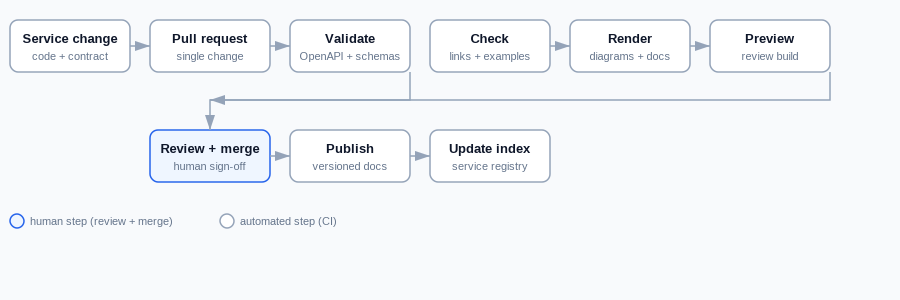
This approach follows the documentation assembly idea explored in the CloudBees article on documenting microservices, which discusses conversion, transclusion, rendering, and assembly as separate stages.
A source-first approach also appears in the practitioner article Your docs live in five formats. Generate one site from the source instead. Its central argument is that maintaining multiple manually copied representations of the same technical facts creates opportunities for inconsistency.
Here is how to turn that idea into an operating process.
1. Validate source contracts. When a pull request changes an OpenAPI file, run a specification validator. Check that the document is syntactically valid and that referenced schemas can be resolved. If the project uses event schemas, validate those as well.
2. Check examples and links. Validate example payloads against their corresponding schemas where practical. Check that links to internal documentation, repositories, and runbooks still resolve. A broken link to an operational runbook can prevent an engineer from finding the procedure needed to resolve a production problem.
3. Render diagrams and documentation. Build Mermaid or PlantUML diagrams from their source definitions. Generate the API reference from the relevant specification. Keep the original files available in the repository — the generated output is a published representation, not the new authority.
4. Create a preview. Give reviewers a preview of the documentation changes before merging the pull request.
5. Publish a versioned release. Publish documentation with an identifiable service version or release reference. Add a visible last-updated date and a changelog entry that links to the relevant pull request or release.
6. Preserve rollback. If a publishing job produces broken documentation, restore the previous published artifact rather than leaving an incomplete site online.
A living documentation process also needs clear ownership. The service team owns service-specific accuracy. The platform team owns shared publishing infrastructure and portal standards.
Aggregate many services without creating a second source of truth
A central documentation page becomes useful when developers work across multiple services.
The problem appears in a Stack Overflow discussion about centralizing Swagger/OpenAPI for 16 Spring Boot microservices. The question describes separate Swagger UI URLs and asks how to make them accessible from one location. One answer demonstrates an OpenAPI gateway approach using Spring Boot and springdoc. It also identifies a cross-origin issue when services do not share the same host.
The useful architectural lesson is that aggregation does not require copying every specification into one manually maintained file. Instead, maintain a service registry or index that points to the published specifications. Each service team continues to own its contract.
There are four failure modes to plan for:
- CORS: A browser-based documentation interface may be unable to retrieve a specification hosted on another origin unless the server permits the required cross-origin requests.
- Authentication: A central interface must not expose protected API descriptions or credentials to users who lack permission.
- Stale URLs: A service may move its documentation endpoint without updating the central registry.
- Version selection: Readers need to distinguish the current API contract from older versions used by existing consumers.
The older Stack Overflow discussion about centralized API documentation reflects the same discovery challenge: developers want one entry point to inspect interfaces across services without hunting through dozens of repositories.
The recommendation is to centralize discovery, not ownership. Keep the service specifications in their respective repositories, publish them through stable versioned URLs, and maintain an index that points to those artifacts.
A decision matrix for team size and operating model
The best documentation setup depends on the number of teams, the rate of service changes, and how difficult it is to discover information across the organization.
| Operating model | Suggested setup | Advantages | Trade-offs |
|---|---|---|---|
| Small team | Service-local Markdown, OpenAPI, Mermaid, static site | Low operational overhead and clear ownership | Developers may need to navigate several repositories |
| Growing team | Shared documentation conventions, Git-backed sites, central index | Better consistency and cross-service discovery | Someone must maintain the index and shared standards |
| Large platform organization | Backstage catalog and TechDocs with service-owned repositories | Central service discovery and distributed documentation ownership | Portal operation, permissions, integrations, and maintenance |
| High contract-change risk | Generated API references, schema validation, compatibility checks, CI publishing | Reduces manual contract duplication and catches certain errors early | Requires reliable contract definitions and pipeline maintenance |
For a small team, start with the simplest system that establishes ownership. Put the service README, OpenAPI definition, diagrams, and operational instructions in the service repository.
For a growing team, introduce a common service template and a central index. Establish naming conventions for service IDs, specification URLs, owners, and release versions.
For a platform organization, consider Backstage and TechDocs, where technical documentation is maintained alongside code and discovered through a software catalog.
There is no reason to introduce a portal simply because the architecture is called microservices. The operational cost is worthwhile only when the discovery and consistency problems justify it.
The practical decision is about ownership:
- Keep facts that change with code near the code.
- Keep cross-service discovery in a shared index or portal.
- Keep human explanations in a location with clear owners and review procedures.
- Generate published representations whenever doing so avoids maintaining duplicate technical facts.
Documentation quality checks that catch drift
Documentation drift happens when the published explanation no longer matches the software.
A service changes its request schema, but the API reference still shows the old field. An endpoint is removed, but another service’s integration guide still links to it. A deployment procedure refers to a configuration variable that no longer exists.
The solution is not to ask developers to remember to update every page. It is to build checks around the artifacts that can be validated automatically.
Start with the OpenAPI definition. Validate the specification whenever a pull request changes it. The OpenAPI Specification defines the contract format that these validation tools operate on.
Next, check API compatibility. A change that removes a field, changes an expected response, or modifies an operation may affect existing consumers. Microsoft explains the importance of API semantics and versioning in its microservices API design guidance. Compatibility checks should flag potentially breaking changes for human review rather than treating every difference as harmless.
Then test the examples. A documentation page may contain a request body that no longer matches the schema. Where possible, validate examples automatically. For executable examples, run integration tests against a suitable test environment.
Add checks for the remaining documentation artifacts:
| Check | What it catches |
|---|---|
| OpenAPI validation | Invalid or incomplete API definitions |
| Schema compatibility | Potentially breaking contract changes |
| Link checking | Missing pages, repositories, and runbooks |
| Example validation | Payloads that do not match documented schemas |
| Diagram rendering | Syntax errors in diagrams-as-code |
| Ownership validation | Missing or invalid service ownership metadata |
| Changelog checks | Releases without corresponding documentation updates |
| Deployment integration tests | Differences between documented and deployed behavior |
Some checks belong in every pull request, while others—like full integration tests against staging environments—can run on a scheduled basis. Automation catches missing files, invalid contracts, and broken references, but it cannot decide whether an architectural explanation makes sense to a new engineer. That is why documentation review belongs in the pull-request process alongside code review.
Putting It Together: A Working Docs-as-Code Example
To verify the pipeline above rather than only describe it, I built a small, reproducible demo repository — microservices-documentation-demo — that runs the exact checks this article recommends.
The repository contains one service — order-service — with:
- An OpenAPI 3.1 contract (
contracts/openapi.yaml) with three endpoints and four schemas. - An
OrderCreatedevent schema. - A Mermaid architecture diagram (
docs/architecture.mmd). - A service documentation page and an operations runbook.
- An example response (
examples/get-order-response.json) validated against theOrderschema. - A Python validator (
scripts/validate-openapi.py) that checks the contract structure and confirms the example matches the schema. - A link checker (
scripts/check-links.py) that verifies every internal reference resolves. - A GitHub Actions workflow that runs the same checks on every pull request.
Running the validator locally produces:
== OpenAPI structural validation ==
  OK  openapi version 3.1.0
  OK  info.title = 'Order Service API'
  OK  paths: 3 endpoints -> /orders, /orders/{orderId}, /orders/{orderId}/status
  OK  components.schemas: Order, OrderItem, OrderStatus, CreateOrderRequest

== Example vs schema ==
  OK  example has all required fields: id, status, items, createdAt
  OK  status 'CONFIRMED' is a valid enum value
  OK  items: 2 valid (required=['sku', 'quantity'], quantity>=1)

RESULT: PASS — contract and example are consistent
The point of the example is the boundary it draws: the contract, schema, and metadata can be generated and checked mechanically, while the service purpose, runbook, and design rationale are written by people. That is the difference between documentation that stays true and documentation that drifts.
FAQ
How do you document multiple microservices in one place?
Use a central index, developer portal, or API documentation gateway that aggregates links to versioned service specifications. Each service team should continue maintaining its own specification in its source repository so the central interface serves as a discovery layer rather than a manually copied duplicate—while accounting for CORS, authentication, stale URLs, and API version selection.
What belongs in a microservice documentation template?
Include the service name and purpose, owning team and technical contact, repository location, dependencies and architecture diagrams, HTTP API and event contracts, configuration and secret references, deployment instructions, health checks and monitoring, operational runbook, and changelog.
Generate fields such as repository metadata, service identifiers, and API references when authoritative source data exists. Keep purpose, operational explanations, troubleshooting procedures, and design rationale under human ownership.
Should microservices documentation live in a wiki or Git repository?
Use both when they serve different responsibilities. A Git repository is generally the better home for information that changes with code, including API contracts, service configuration references, and diagrams-as-code. A wiki can be useful for organization-wide knowledge, discussions, and cross-service explanations.
The deciding factor is not the name of the tool. It is whether the correct team owns the information and whether updates happen when the underlying system changes.
How do you prevent microservices documentation drift?
Connect documentation to the development workflow. Validate OpenAPI definitions, check schema compatibility, test examples, render diagrams, check internal links, and review ownership metadata in CI. Publish versioned documentation and retain changelog information. For deployed interfaces, add integration checks against a suitable test environment.
Automated checks catch structural problems, while human review remains necessary for operational explanations, architecture decisions, and troubleshooting guidance.
Related Articles
- What Are Microservices? A Simple Explanation for Beginners
- 15 Microservices Architecture Components Explained
- Microservices Architecture Diagram Explained + Examples
- Microservices vs Monolithic: Pros, Cons & Differences
- API Gateway in Microservices: Request Flow & Examples
- Database per Service Microservices: Ownership and Isolation
- Distributed Transactions in Microservices: Sagas & Outbox