Many teams compare microservices vs monolithic architecture because they assume microservices are the more modern choice.
Sometimes they are.
But microservices are not automatically better.
A monolithic application can be the smartest architecture for a small team, an MVP, a simple product, or a system that needs to move fast. Microservices become useful when the application is large enough, the business boundaries are clear enough, and the team has the operational maturity to handle distributed systems.
This guide explains the difference between monolithic and microservices architecture, compares the pros and cons, and helps you decide which approach fits your system.
Quick Answer A monolithic architecture builds the application as one deployable unit, usually with one codebase and a shared database. Microservices architecture splits the application into smaller independent services that can be developed, deployed, and scaled separately. A monolith is usually better for small teams, MVPs, and simple systems. Microservices are better when the system is large, complex, and needs independent scaling, deployment, and team ownership.
Quick Decision Flow
Not sure where to start? Here is a quick cheat sheet for decision-making:
- Small team and uncertain product → Start with a modular monolith.
- Independent teams and clear domain boundaries → Consider microservices.
- Strong operational platform already available → Microservices become more realistic.
- Mainly trying to “scale” one simple application → First consider scaling the monolith.
Who This Guide Is For
This guide is useful if you are:
- choosing an architecture for a new application,
- comparing a monolith with microservices,
- planning an MVP,
- working inside a growing monolithic application,
- or trying to decide whether your system should stay monolithic, become modular, or move toward microservices.
The goal is not to make one architecture look better than the other. The goal is to understand the tradeoffs clearly enough to make a good technical decision.
What Is Monolithic Architecture?
Monolithic architecture means the application is built and deployed as one unit.
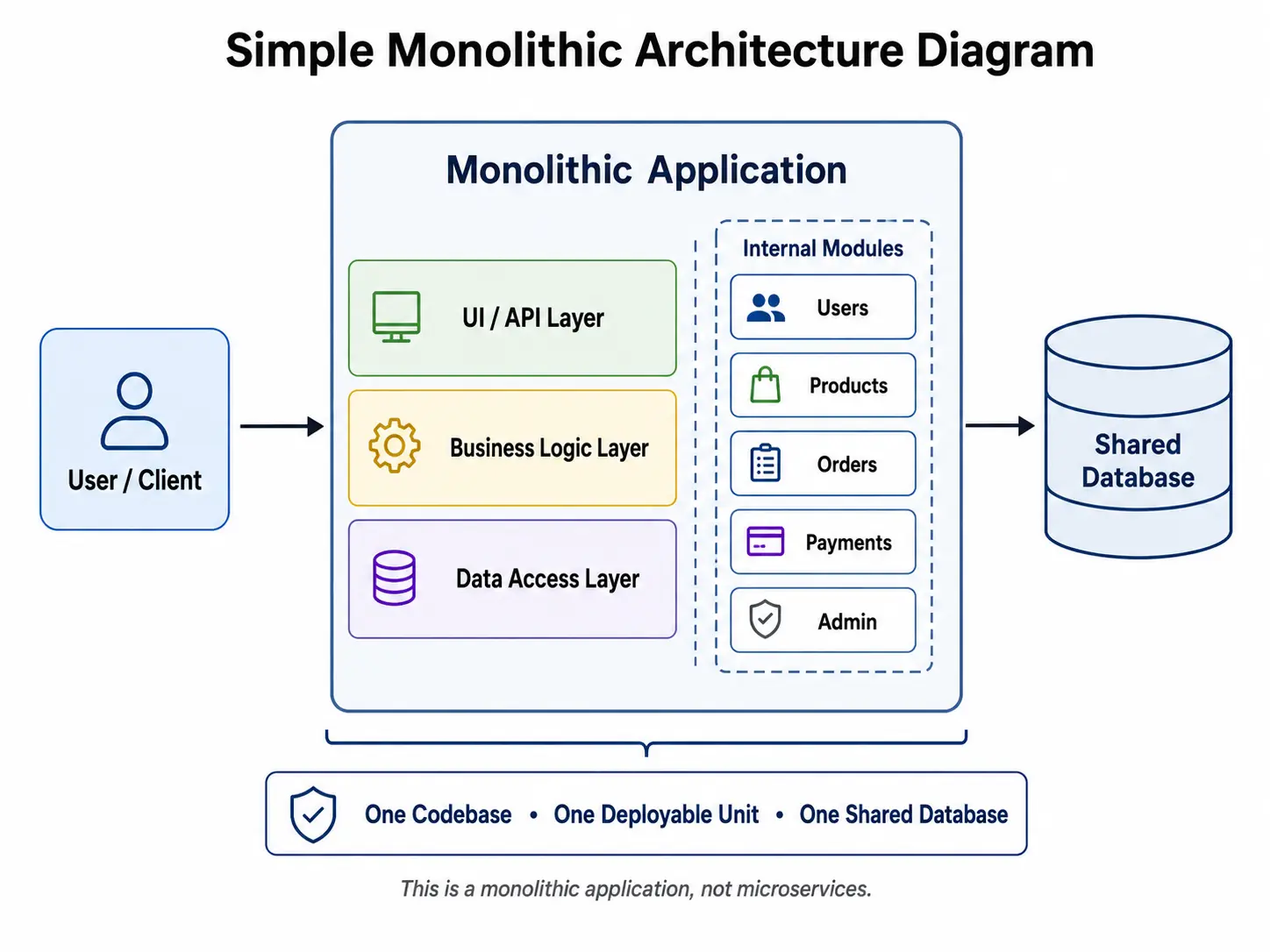
In a typical monolithic application, the UI or API layer, business logic, and data access code live inside one codebase or one deployable application. The system usually talks to one shared database.
That does not mean the code must be messy.
A monolith can still be clean, layered, modular, and well-organized. For example, a monolithic backend can have separate modules for users, products, orders, payments, reports, and admin features.
The main idea is simple: even if the code is internally divided, the application is usually built, tested, and deployed together.
This makes monoliths easier at the beginning. You can run the whole system locally, debug one application, manage one deployment pipeline, and avoid network calls between services.
The problem usually appears when the product, team, and codebase grow. Over time, a monolith can become harder to change if boundaries are unclear, modules are tightly coupled, and many developers are editing the same parts of the system.
A monolith is not bad architecture.
A poorly structured monolith is bad architecture.
For a visual architecture explanation of services, gateways, and communication flow, see Microservices Architecture Diagram Explained.
The diagram below shows how a monolithic application is usually deployed as one application with one shared database.
What Is Microservices Architecture?
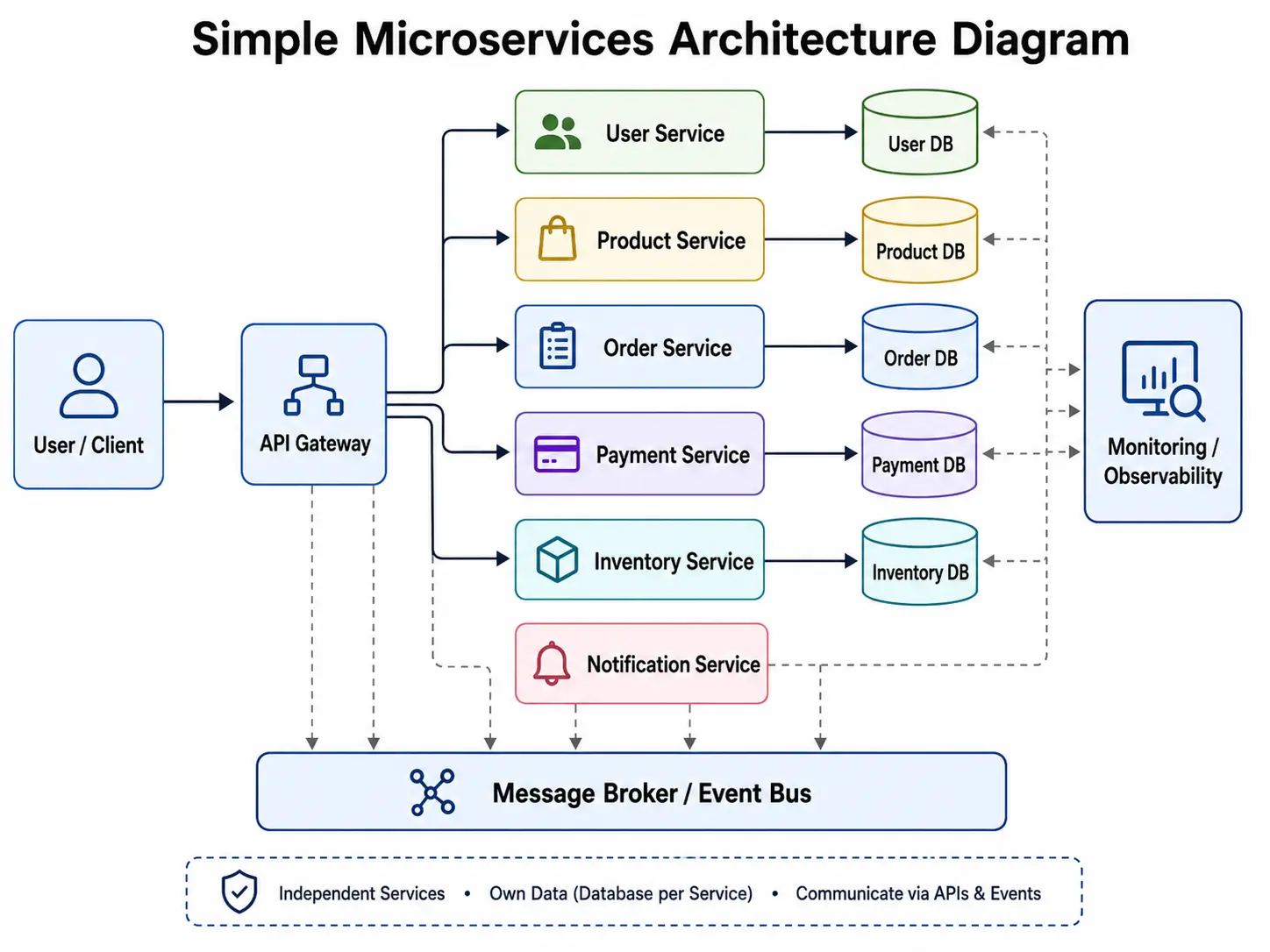
Microservices architecture splits a system into smaller independent services. Each service owns a specific business capability, such as user accounts, product catalog, orders, payments, inventory, search, or notifications.
Instead of one application handling everything, each service has its own responsibility and communicates with other services through APIs, events, or messages.
For example, an Order Service may call a Payment Service to process payment, send an event to an Inventory Service to reduce stock, and notify a Notification Service to send an email.
Each service can often be developed, deployed, and scaled independently. This is one of the main advantages of microservices over monolithic architecture.
But microservices also require more infrastructure and discipline. A real microservices system may need an API gateway, service discovery, database per service, message broker, monitoring, logging, tracing, containers, CI/CD pipelines, and resilience patterns.
That is why microservices are not just a coding style. They are also an operational model.
For a deeper breakdown of the main components of microservices architecture, read the related guide on API gateways, service discovery, databases, brokers, and observability.
The diagram below shows how microservices split a system into independent services that communicate through APIs or events.
Microservices vs Monolithic Architecture: Quick Comparison Table
| Feature | Monolithic Architecture | Microservices Architecture |
|---|---|---|
| Codebase | One main codebase or application | Multiple smaller services |
| Deployment | Deploy the whole application together | Deploy services independently |
| Scaling | Scale the whole application | Scale only the service that needs it |
| Database | Usually one shared database | Each service may own its own data |
| Development speed | Faster at the beginning | Slower at first because setup is heavier |
| Testing | Simpler end-to-end testing early | Requires service, integration, and contract testing |
| Debugging | Easier because everything is in one place | Harder because requests cross services |
| Performance | Often faster for simple flows | May add network latency between services |
| Reliability | Simpler failure paths, but one bug may affect the whole app | Better isolation when designed well, but more failure points |
| Team structure | Good for one small team | Good for multiple teams owning different areas |
| Technology choices | Usually one main stack | Different services can use different stacks when justified |
| Cost | Lower early infrastructure cost | Higher cost due to infrastructure and operations |
| Operational complexity | Lower | Higher |
| Best for | MVPs, small teams, simple products | Large systems, complex domains, independent teams |
This table gives a practical monolithic vs microservices comparison, but the right choice depends on context.
Architecture is not a popularity contest. It is a tradeoff.
Key Differences Between Monolithic and Microservices Architecture
The main difference between monolithic and microservices architecture is not only the number of services. The deeper difference is how the system is structured, deployed, scaled, tested, and operated.
Let’s break that down.
1. Codebase and Structure
A monolithic application has one main codebase. Features may be divided into folders, layers, or modules, but they still belong to one application.
For example, a monolithic e-commerce application may have code for users, products, orders, payments, and admin features inside the same project.
Microservices split the system into multiple services. Each service has its own codebase or at least its own deployable unit. A User Service, Payment Service, and Inventory Service may all be separate applications.
This independence can help large teams move faster, but it also means more repositories, pipelines, configuration, versioning, and coordination.
For a small product, that extra structure may slow you down. For a large product with many teams, it may be exactly what you need.
2. Deployment
In a monolith, a small change often requires deploying the whole application.
That can be fine for small systems. If the deployment is simple and the team is small, one deployment may actually be easier to manage.
In microservices, each service can be deployed independently. A team can update the Payment Service without redeploying the Product Service, Inventory Service, or Notification Service.
This is useful when many teams are releasing frequently.
But independent deployment is not free. It requires mature CI/CD, versioning, automated testing, rollback strategies, monitoring, and clear service ownership.
If those practices are missing, microservices can create more deployment problems than they solve.
3. Scalability
A monolith is usually scaled as one unit.
If the checkout feature needs more capacity, you may need to run more copies of the whole application, even if the product catalog, admin panel, and reporting features do not need extra resources.
Microservices allow more targeted scaling.
If the Search Service receives heavy traffic, you can scale that service without scaling the whole system. If the Notification Service has a large queue of emails, you can add more workers only for that service.
This is one of the strongest advantages of microservices over monolithic systems.
But it only matters when different parts of the system truly have different workloads.
For a small CRUD application, microservices may add complexity without giving meaningful scaling benefits.
4. Database and Data Ownership
A monolithic application usually uses one shared database. This makes querying and reporting easier. You can join users, orders, payments, and products in one place.
Microservices usually prefer service-owned data. The Order Service owns order data. The Payment Service owns payment data. The Inventory Service owns inventory data.
This improves independence because services do not constantly depend on the same database schema.
But it creates new challenges.
Reporting becomes harder. Joins across services are not simple. Data consistency becomes more complex. You may need events, eventual consistency, read models, or dedicated reporting databases.
This is why the database per service pattern should be used carefully. It improves service independence, but it is not free.
Related future post: Database per Service Pattern Explained
5. Performance
Monoliths can be faster for simple workflows because many calls happen inside one application process.
A checkout function may call inventory and payment logic directly in memory. There may be no network call between services because everything is inside the same application.
Microservices often add network calls.
A request may travel from the API gateway to one service, then to another service, then to a message broker, then to a database. Each network hop adds latency and possible failure.
That does not mean microservices are slow.
Microservices can scale better when different parts of the system have different workloads. But for simple workflows, a monolith may be faster and easier.
The practical rule is this:
A monolith is often simpler and faster for straightforward flows. Microservices are useful when the system needs independent scaling, independent deployment, or independent team ownership.
6. Testing and Debugging
Monoliths are often easier to test and debug early.
You can run the application locally, put a breakpoint in the code, and follow the request inside one process. End-to-end tests are usually easier to set up because there are fewer moving parts.
Microservices need more discipline.
A single user action may pass through five services. To understand what happened, you need logs, metrics, distributed tracing, correlation IDs, and service-level dashboards.
You may also need contract testing to make sure services do not break each other when APIs change.
For microservices, observability is not optional.
Without it, debugging becomes guesswork.
Related future post: Microservices Testing Strategy Explained Related future post: Monitoring Microservices After Deployment
7. Reliability and Failure Isolation
A monolith has simpler failure paths. There are fewer moving parts, fewer network calls, and fewer dependencies between deployed services.
But a serious bug in a monolith can affect the whole application. If the application crashes, everything may be down.
Microservices can isolate failures better.
If the Notification Service fails, checkout may still complete while email sending is retried later. If the Recommendation Service is slow, the main product page may still load without recommendations.
However, microservices also introduce more failure points.
Network calls can fail. Services can time out. Dependencies can be unavailable. Retries can overload another service if they are not controlled.
Microservices solve some reliability problems, but they create distributed-systems problems. Managing these network calls often requires infrastructure like an API Gateway and service discovery in microservices.
8. Team Ownership
A monolith works well when one small team owns the whole product. Everyone can understand the system, coordinate changes, and deploy together.
Microservices fit better when multiple teams own different business capabilities.
For example:
- one team owns payments,
- another owns search,
- another owns inventory,
- another owns notifications,
- another owns checkout.
This is where microservices can be powerful. They allow teams to work with less blocking.
But if one small team owns ten microservices, the team may spend more time managing services than building product features.
A simple rule:
If your team is small, a monolith is usually easier. If your organization has multiple teams that need independent ownership, microservices may make more sense.
9. Cost and Operational Complexity
A monolith usually has lower early cost.
You may need one application server, one database, one deployment pipeline, and basic monitoring.
Microservices need more.
More services, more pipelines, more environments, more logs, more dashboards, more alerts, more infrastructure, and more operational knowledge.
This is one of the most common hidden disadvantages of microservices over monolithic architecture.
Microservices are not just about splitting code.
They also split deployment, monitoring, ownership, failure handling, data management, and operations.
Monolithic Architecture: Advantages and Disadvantages
Monolithic architecture has real advantages, especially at the beginning of a project. It also has real disadvantages when the system grows without clear boundaries.
Advantages of Monolithic Architecture
The main advantages of monolithic architecture are simplicity, speed, and lower operational cost.
A monolith is usually easier to start because the team works in one codebase and deploys one application. Local development is simpler. Debugging is easier. End-to-end testing is often more direct.
Monolithic architecture is especially useful when:
- you are building an MVP,
- your team is small,
- the product is still changing,
- you need to launch quickly,
- you want lower infrastructure cost,
- your features do not need independent scaling yet,
- your domain is not complex enough to justify multiple services.
A small internal dashboard for a company does not need microservices. A clean monolith is usually enough.
A simple SaaS app with login, dashboard, billing, reports, and admin features can also start as a well-structured monolith.
Many successful products begin this way because it allows the team to focus on customers and product-market fit instead of distributed systems.
Disadvantages of Monolithic Architecture
The disadvantages of monolithic architecture usually appear as the system grows.
A large monolith can become tightly coupled. One change may affect unrelated areas. Large deployments can become risky. Many developers working in the same codebase can slow each other down.
It can also be harder to scale individual features. If only one part of the application needs more resources, you may still need to scale the whole app.
Technology choices are harder to change too. If the whole application is built with one language and framework, replacing one part of the system may be difficult.
A monolith can also become difficult when different teams need different release schedules. If every change must wait for one shared deployment, teams may block each other.
But again, the monolith itself is not always the problem.
Lack of boundaries is the problem.
Microservices Architecture: Advantages and Disadvantages
Microservices architecture can solve important problems in large systems, but it also creates new ones.
That is why comparing microservices vs monolithic pros and cons must be done carefully.
Advantages of Microservices Over Monolithic Architecture
The main advantages of microservices over monolithic architecture are independent deployment, independent scaling, and stronger team ownership.
A team can deploy one service without redeploying the whole system. A high-traffic service can be scaled separately. Different services can use different technologies when there is a real reason.
Microservices can also improve fault isolation. If designed well, one failing service does not have to bring down the whole system.
They are a better fit for complex domains where different business capabilities have different rules, data, performance needs, and release cycles.
Microservices also support frequent releases when CI/CD is mature. Teams can move independently without waiting for one large deployment window.
For example, a large marketplace may have separate teams for search, payments, orders, delivery, seller tools, buyer accounts, and notifications. In that case, microservices can help teams own and release their parts independently.
Disadvantages of Microservices Over Monolithic Architecture
The disadvantages of microservices over monolithic architecture are mostly about complexity.
You now have a distributed system. Services communicate over the network. Network calls can fail. Latency increases. Data consistency becomes harder. Transactions across services are not simple.
Debugging also becomes harder. You need monitoring, logging, tracing, metrics, alerts, and good operational habits.
Service boundaries are difficult to design. If you split services too early or in the wrong way, you may create a distributed monolith: many services that are technically separate but still tightly coupled.
Too many small services can become a mess. Every service adds code, deployment, ownership, infrastructure, and support cost.
A common bad decision is splitting a small CRUD app into ten services before the product has users. The team then spends more time managing Docker files, deployments, logs, and service communication than building useful features.
Microservices solve some scaling and team problems, but they create distributed-systems problems.
When to Use Monolithic Architecture
Use monolithic architecture when simplicity is more valuable than distribution.
A monolith is usually the better choice when:
- you are building an MVP,
- the team is small,
- the business domain is simple,
- you need to launch quickly,
- the product may change direction often,
- the application does not have very different scaling needs per feature,
- a single database is enough,
- you do not yet have strong DevOps and observability,
- you want lower infrastructure cost,
- you need simpler testing and debugging.
A small SaaS app with login, dashboard, billing, reports, and admin features can often start as a well-structured monolith.
That does not mean you should write messy code. You can still use clear modules, layers, domain boundaries, and good tests. The goal is to keep the system simple without making it chaotic.
This is the real answer to “when to use monolithic architecture”:
Use it when your main problem is product development, not distributed scaling.
When to Use Microservices Architecture
Use microservices architecture when the system has enough complexity to justify the cost.
Microservices are usually a better choice when:
- the application is large and complex,
- different parts of the system need to scale differently,
- multiple teams need to work independently,
- independent deployments are important,
- the system has clear business boundaries,
- a failure in one area should not bring down the whole system,
- different services have different data or performance needs,
- you already have CI/CD, monitoring, logging, tracing, and automation,
- the business value of independence is greater than the operational cost.
An e-commerce platform with catalog, search, cart, checkout, payment, inventory, delivery, and notifications may benefit from microservices once it has scale, team ownership, and operational maturity.
The key phrase is “once it has.”
Many systems do not need microservices on day one.
Modular Monolith: The Middle Ground
A modular monolith is one deployable application that is internally divided into clear modules.
It gives you some benefits of structure without the complexity of distributed services. You still deploy one application, but the code is organized around business capabilities.
For example, an e-commerce modular monolith may have separate modules for users, catalog, cart, orders, payments, inventory, and notifications. These modules should have clear boundaries and avoid reaching directly into each other’s internal data.
For many teams, the best path is not “monolith forever” or “microservices from day one.”
The best path is often a modular monolith first, then microservices only when real needs appear.
A modular monolith helps you discover good service boundaries before you split the system. That is much safer than guessing boundaries too early.
Related future post: Modular Monolith vs Microservices
Example: E-commerce App as a Monolith vs Microservices
An e-commerce application is a good example because most developers understand the flow.
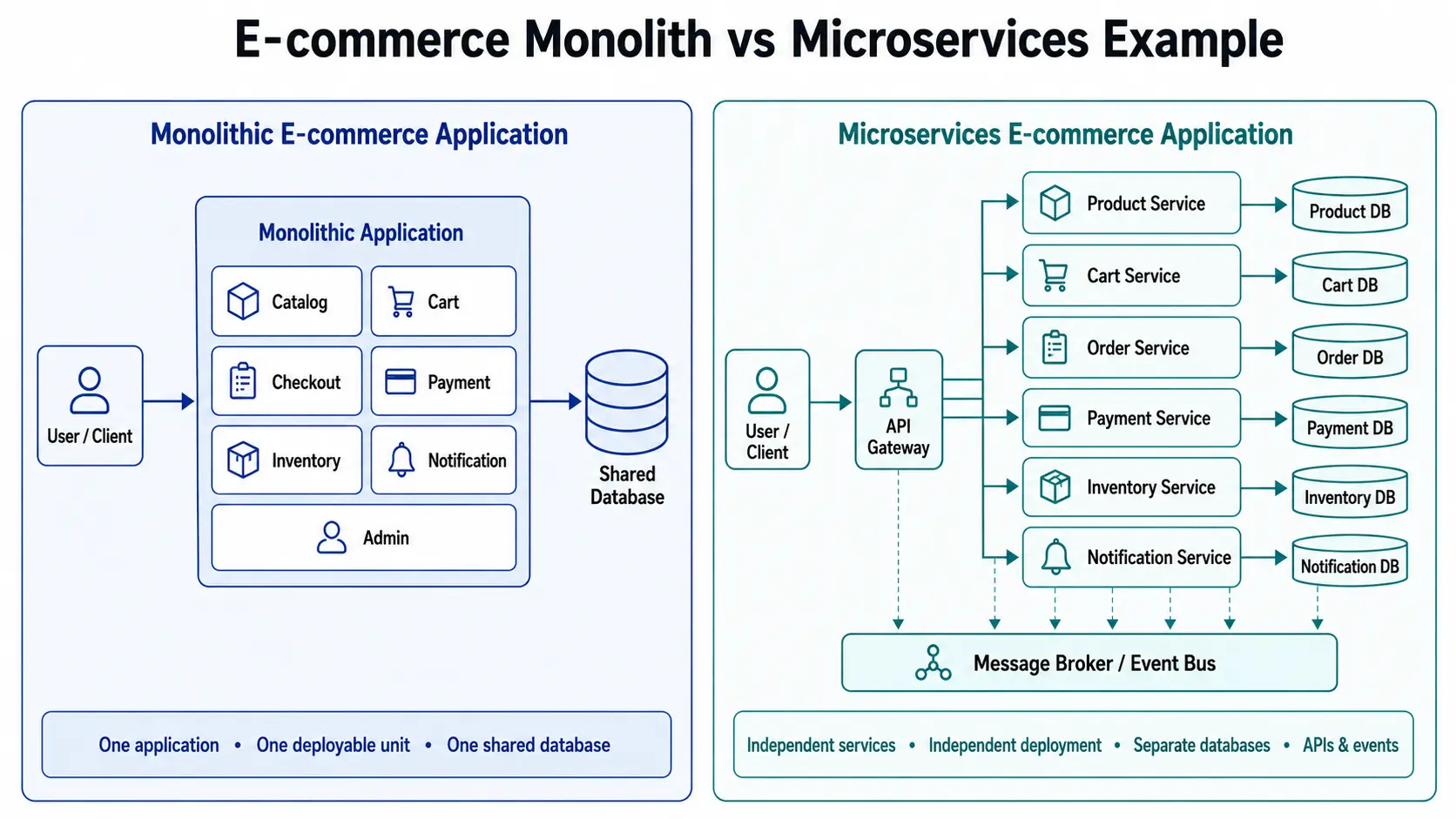
In a monolithic e-commerce application, the same application may handle:
- user accounts,
- product catalog,
- shopping cart,
- checkout,
- payment,
- inventory,
- notifications,
- admin panel.
All of these features usually live in one application and use one shared database.
In a microservices e-commerce application, the system may be split into:
- User Service,
- Product Service,
- Cart Service,
- Order Service,
- Payment Service,
- Inventory Service,
- Notification Service,
- API Gateway,
- message broker or event bus,
- service-owned databases.
A checkout request in a monolith may call internal functions inside the same application. The checkout code may directly call payment logic, inventory logic, and notification logic.
In microservices, the request may pass through the API gateway, then reach the Order Service. The Order Service may call the Payment Service, publish an event to update inventory, and trigger the Notification Service after the order is confirmed.
This flow is easier to understand visually.
For a visual walkthrough of request flow in microservices, see Microservices Architecture Diagram Explained.
This side-by-side example shows the same e-commerce system as a monolith and as microservices.
Common Mistakes When Choosing Between Monolith and Microservices
The biggest mistake is choosing microservices too early.
Many teams choose microservices because large companies use them. But the largest global tech companies reached a level of scale and team complexity that most products do not have at the beginning.
Another mistake is assuming monolith means bad architecture.
A monolith can be clean, modular, tested, and maintainable. Microservices can also be badly designed, tightly coupled, and painful to operate.
A common technical mistake is splitting services by technical layers.
For example:
- Frontend Service
- Business Logic Service
- Database Service
That is not a good microservices design. Services should usually be split around business capabilities, not technical layers.
Another mistake is creating too many tiny services. Small services sound clean, but every service needs deployment, monitoring, ownership, testing, and support.
Some teams also share one database across all services and call it microservices. This often creates tight coupling because services still depend on the same tables and schema.
Other common mistakes include:
- ignoring monitoring and tracing,
- using microservices without CI/CD,
- doing a big-bang rewrite from monolith to microservices,
- choosing architecture based on trends instead of product needs,
- creating services before the business boundaries are clear,
- copying another company’s architecture without having the same scale or problems.
The better question is not:
“Is microservices better than monolithic?”
The better question is:
“What problem are we solving?”
Decision Matrix: Monolith or Microservices?
| Situation | Better Choice | Why |
|---|---|---|
| MVP or early product | Monolith | Faster to build, test, and change |
| Small team | Monolith | Less operational overhead |
| Simple CRUD application | Monolith | Microservices would add unnecessary complexity |
| Tight budget | Monolith | Lower infrastructure and DevOps cost |
| Fast launch needed | Monolith | One codebase and one deployment are simpler |
| Large complex product | Microservices | Clear boundaries and independent services can help |
| Multiple teams | Microservices | Teams can own and deploy services independently |
| Different scaling needs | Microservices | Scale only the parts that need more resources |
| Independent deployments required | Microservices | Services can be released separately |
| Strong DevOps and monitoring already exist | Microservices | The team can support distributed operations |
| Unclear future architecture | Modular monolith | Keeps boundaries flexible without distribution |
| Existing monolith is becoming too hard to change | Modular monolith, then selective microservices | Improve boundaries first, extract only where needed |
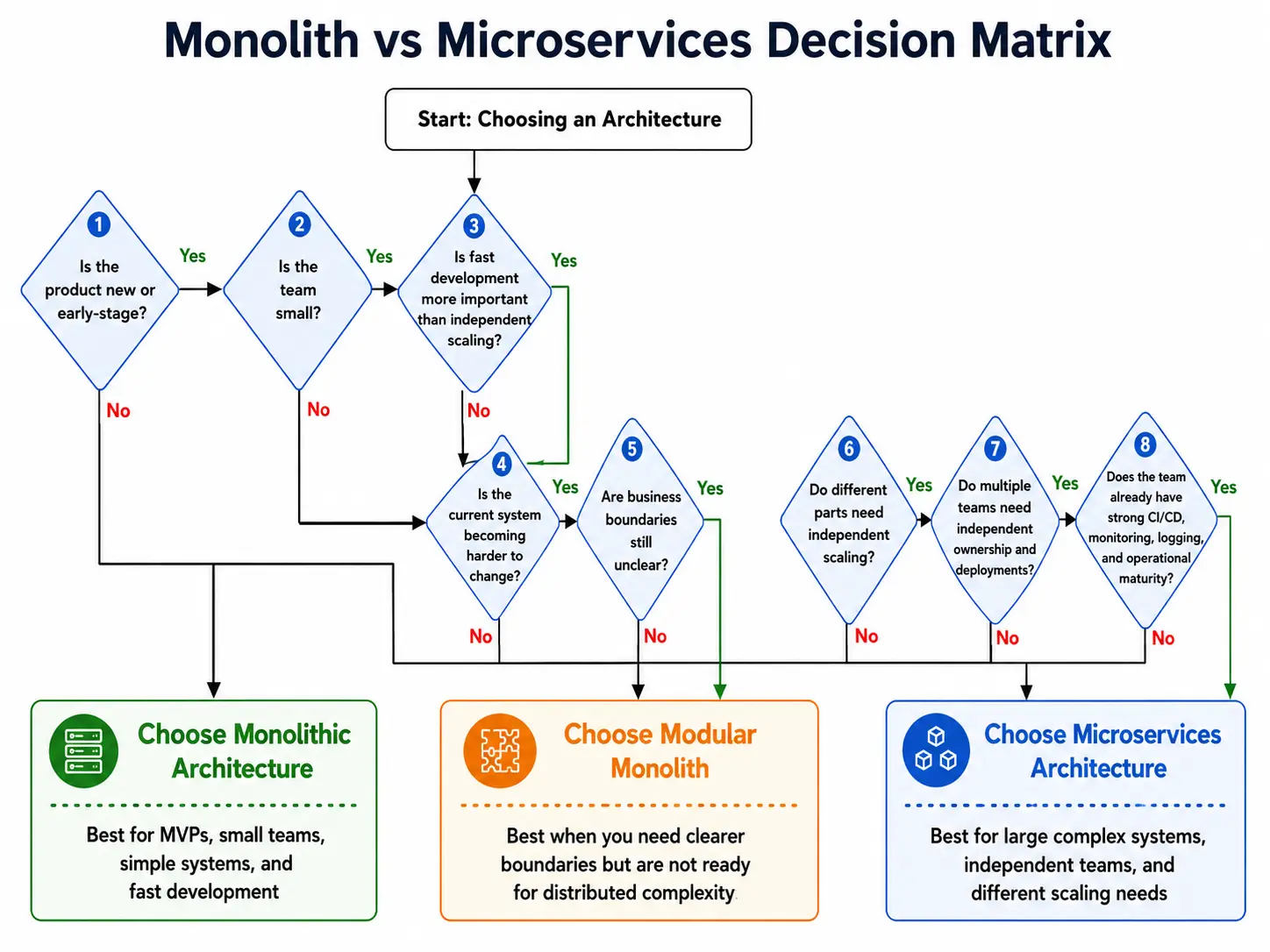
The decision flowchart below summarizes when to choose a monolith, modular monolith, or microservices.
Should You Migrate from Monolith to Microservices?
A monolith to microservices migration should be gradual.
Do not rewrite everything at once unless there is a very strong reason. Big-bang rewrites are risky because they create a long period where the old system and new system both need attention.
Start by identifying real pain points.
Ask questions like:
- Is deployment too risky?
- Is one module changing much faster than the rest?
- Does one feature need separate scaling?
- Is one team blocked by another team?
- Are parts of the monolith already clearly separated?
- Is the current pain technical, organizational, or both?
Before extracting services, improve modularity inside the monolith. Create clearer boundaries. Reduce coupling. Separate business areas. Add tests.
Then extract services only when there is a clear reason.
One common approach is the strangler pattern, where new functionality is built outside the monolith gradually, while old parts are replaced step by step.
This topic deserves its own guide because migration is more complex than a simple comparison.
Related future post: Monolith to Microservices Migration: Step-by-Step Guide
Brief Notes on Related Architecture Choices
Some related topics are worth mentioning, but they deserve separate articles.
SOA vs Microservices vs Monolithic Architecture
A monolith is one deployable application.
SOA and microservices both involve services, but SOA is often associated with broader enterprise integration patterns, while microservices focus on smaller, independently deployable services around business capabilities.
Related future post: SOA vs Microservices vs Monolithic Architecture
Serverless vs Monolith
Serverless can reduce server management, but it does not automatically remove architectural complexity.
A serverless system can still become hard to maintain if boundaries are unclear.
Related future post: Serverless vs Microservices vs Monolith
Distributed Monolith vs Microservices
A distributed monolith happens when services are deployed separately but are still tightly coupled.
It has the operational cost of microservices without the independence microservices are supposed to provide.
Related future post: Distributed Monolith vs Microservices
Final Recommendation
The best architecture is the one that solves your current problem without creating unnecessary future problems.
Start with a monolith or modular monolith if the product is new, the team is small, and speed matters. This lets you build, learn, and change direction without paying the cost of distributed systems too early.
Move toward microservices when the system has clear complexity, real scaling requirements, multiple teams, independent deployment needs, and strong operational maturity.
A good monolith is better than bad microservices.
Good microservices require boundaries, automation, observability, CI/CD, ownership, and discipline. Without those, microservices can slow a team down instead of helping it.
So when comparing microservices vs monolithic architecture, do not ask which one is more modern.
Ask which one fits your product, team, scale, and operational readiness.
Related Articles
- Microservices Architecture Diagram Explained
- Microservices Architecture Components Explained With Examples
Frequently Asked Questions About Microservices vs Monolithic Architecture
1. What is the difference between monolithic and microservices architecture?
The main difference is deployment and structure. A monolithic architecture builds the system as one deployable application. Microservices architecture splits the system into smaller independent services that can be developed, deployed, and scaled separately.
2. Is microservices better than monolithic architecture?
Not always. Microservices are better for some large and complex systems, but monoliths are often better for small teams, MVPs, and simple applications.
3. When should you use monolithic architecture?
Use monolithic architecture when the team is small, the product is early, the domain is simple, the budget is limited, and fast development is more important than independent scaling.
4. When should you use microservices architecture?
Use microservices architecture when the application is large, multiple teams need independent ownership, different parts need separate scaling, and the team has strong CI/CD, monitoring, logging, and tracing.
5. What are the pros and cons of microservices and monolithic architecture?
Monoliths are simpler, cheaper, easier to debug, and faster to build early, but they can become harder to scale and maintain as they grow. Microservices allow independent deployment, scaling, and team ownership, but they add infrastructure, debugging, data consistency, and operational complexity.
6. Are monolithic applications faster than microservices?
For simple workflows, monolithic applications can be faster because they avoid network calls between services. Microservices can scale better when different parts of the system have different workloads, but they usually add more network and operational complexity.
7. What is a modular monolith?
A modular monolith is one deployable application that is internally divided into clear modules. It keeps deployment simple while improving code organization and boundaries.
8. Can you migrate from monolithic to microservices later?
Yes. Many teams start with a monolith or modular monolith and migrate gradually when real scaling, deployment, or team ownership problems appear. The safest approach is usually incremental extraction, not a full rewrite.
9. What is the difference between SOA, monolithic architecture, and microservices?
A monolith is one deployable application. SOA is a broader service-based architecture often used in enterprise integration. Microservices are smaller, independently deployable services usually organized around business capabilities.
10. Should startups use microservices or monolithic architecture?
Most startups should begin with a monolith or modular monolith unless they already have a clear reason for microservices. Early-stage startups usually benefit more from speed, simplicity, and low operational cost.