Microservices are a way to build an application as a collection of independently owned services instead of one large deployable system.
Each service focuses on a meaningful business capability, such as users, products, orders, payments, inventory, shipping, or notifications. The services work together through APIs, events, or messages to provide the complete application experience.
The simple idea is this:
Microservices divide an application into smaller services that can often be developed, deployed, operated, and scaled more independently.
That independence can be valuable for large systems and organizations with multiple teams. However, microservices also introduce network communication, distributed data, more deployments, harder debugging, and additional operational requirements.
This guide explains microservices in simple language, using beginner-friendly examples, practical trade-offs, and clear guidance about when microservices are—or are not—the right choice.
Key Takeaways
- Microservices are an architectural style in which an application is divided into independently owned services.
- A microservice focuses on one meaningful business capability, such as orders, payments, or notifications.
- Services usually communicate through APIs, events, or messages.
- Microservices can support independent deployment, targeted scaling, clearer team ownership, and failure isolation.
- Microservices also create distributed-system challenges involving networks, data consistency, monitoring, testing, and operations.
- Microservices are not automatically better than monolithic architecture.
- Many teams should begin with a monolith or modular monolith.
- Microservices work best when service boundaries are clear and the team can support the additional operational complexity.
Quick Answer: What Are Microservices?
Microservices are independently owned software services that work together to form one application.
Each service handles a specific business capability, such as:
- User accounts
- Product catalog
- Shopping carts
- Orders
- Payments
- Inventory
- Shipping
- Notifications
A microservices architecture differs from traditional monolithic architecture because the application is not built and operated primarily as one large deployable unit.
Instead, services can often be developed, tested, deployed, and scaled separately.
Simple definition: Microservices are an architectural style in which one application is divided into multiple services, with each service owning a clear business capability and communicating through defined contracts.
For example, an online store might contain separate services for users, products, carts, orders, payments, inventory, and notifications. Together, those services provide the complete shopping experience.
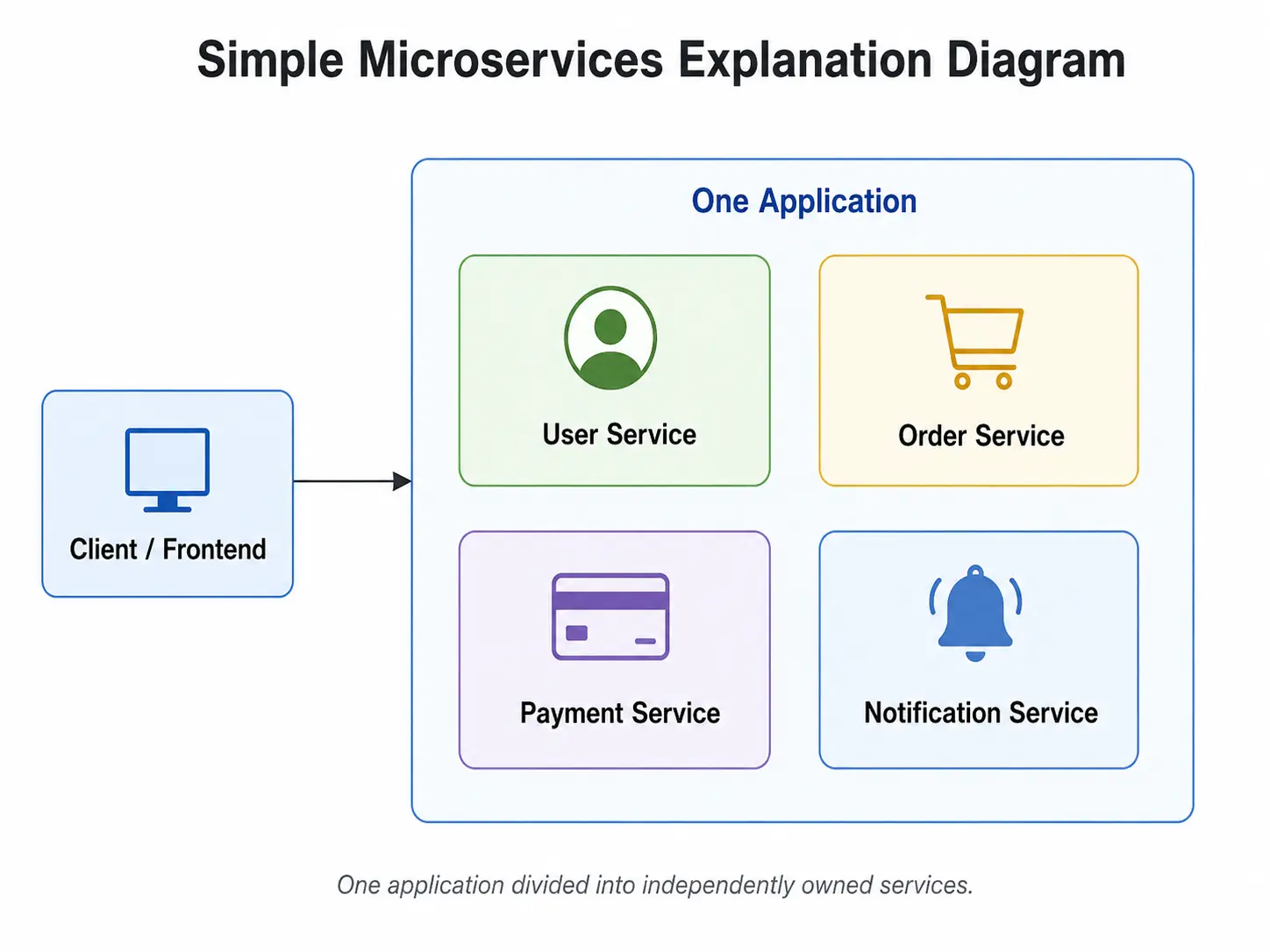
What Is a Microservice in Simple Terms?
A microservice is a software service that performs one main business responsibility.
For example:
- A User Service manages user accounts and profiles.
- An Order Service creates and tracks orders.
- A Payment Service manages payment attempts and refunds.
- An Inventory Service tracks stock and reservations.
- A Notification Service sends emails, SMS messages, or push notifications.
Each service is a separately owned part of a larger application. Depending on the system, it may have its own:
- Source code
- API or event contracts
- Data boundary
- Deployment process
- Runtime resources
- Monitoring
- Team ownership
A useful way to think about it is:
A microservice is not simply a small amount of code. It is an independently owned part of a larger system with a clear responsibility and defined boundaries.
The word service matters.
In software architecture, a service is a running software component that provides a capability to clients or other services. Those consumers interact with it through a defined interface rather than depending on its private implementation.
For beginners, a restaurant provides a useful analogy.
A restaurant is one business, but different teams have different responsibilities:
- The cashier accepts orders.
- The kitchen prepares food.
- The inventory team manages supplies.
- The delivery team handles deliveries.
- The support team handles customer issues.
Each team has its own responsibility, but they collaborate to serve the customer.
Microservices use a similar idea in software: one application contains multiple services with clear responsibilities that work together.
Microservices Meaning in Simple Words
The meaning of microservices becomes easier to understand when compared with one large application.
In a traditional application, features may live in one codebase and be deployed together. This is commonly called a monolithic architecture.
A monolith is not automatically bad.
A well-designed monolith is often the best starting point for:
- Small teams
- Early products
- Minimum viable products
- Simple applications
- Domains that are still changing
- Systems with limited operational resources
In microservices architecture, the application is divided around business capabilities.
Instead of one large application containing user management, products, checkout, payments, inventory, and notifications, the system might contain:
- User Service
- Product Service
- Cart Service
- Order Service
- Payment Service
- Inventory Service
- Shipping Service
- Notification Service
Each service has a clear boundary.
A boundary defines:
- What the service owns
- Which business rules belong inside it
- Which data it controls
- Which operations it exposes
- Which team is responsible for it
This leads to one of the most important microservices principles:
Services should be loosely coupled.
Loose coupling means a service should depend as little as possible on the private details of other services.
For example, Order Service should not depend directly on Payment Service database tables. It should communicate through a published API, command, event, or another controlled contract.
Expert note: Microservices are not mainly about making code smaller. They create ownership, deployment, data, and scaling boundaries around business capabilities.
Why Do Teams Use Microservices?
Teams use microservices when one application becomes difficult to change, release, scale, or manage across several teams.
As a product grows, different business capabilities may develop different requirements.
For example:
- Payment logic may require careful security controls and release processes.
- Product catalog traffic may increase significantly during a sale.
- Notifications may need to process large background workloads.
- Search may require different storage and scaling technology.
- Several teams may need to release changes independently.
Microservices can help by allowing different services and teams to operate with greater independence.
| Benefit | What It Means | Beginner Example |
|---|---|---|
| Independent deployment | A service can be released without deploying the complete application | Payment Service can be updated without redeploying Product Service |
| Targeted scaling | A busy service can receive more resources than other services | Product Service scales during a sale |
| Team ownership | A team can own one capability from development through production | One team owns checkout while another owns notifications |
| Technology flexibility | A service can use a different tool when there is a justified need | Search Service uses a search engine while Order Service uses a relational database |
| Failure isolation | A service failure may be contained when dependencies are designed carefully | Email failure does not necessarily prevent order creation |
| Clear business boundaries | Services can align with meaningful business responsibilities | Orders, payments, inventory, and shipping remain separated |
These benefits are real, but they are not free.
Microservices move some complexity out of one codebase and into the distributed system.
Instead of debugging one application, teams may need to trace requests across several services.
Instead of managing one deployment, teams may manage many independent releases.
Instead of using one database transaction, teams may need to coordinate data changes across several services and accept eventual consistency.
That is why microservices should be a deliberate architecture decision rather than a trend to copy.
How Do Microservices Work?
Microservices work by allowing independently owned services to collaborate through defined communication contracts.
A simplified order flow might look like this:
- A customer clicks “Place Order.”
- The frontend sends the request to a backend entry point.
- An API Gateway or another routing layer receives the request.
- Order Service validates the request and creates an order with a pending status.
- Payment Service attempts to process the payment.
- Inventory Service reserves the required stock when the workflow reaches that stage.
- Notification Service sends a final confirmation only after the required payment and inventory outcomes succeed.
- If payment or inventory fails, the order may remain pending, be cancelled, or trigger a refund workflow.
The customer sees one business action, but several services may participate behind the scenes.
For a visual explanation of request and event flows, read Microservices Architecture Diagram Explained + Examples.
APIs, Events, and Messages
Microservices commonly communicate through synchronous APIs and asynchronous messages.
An API allows one service or client to request an operation or retrieve information from another service.
For example:
Order Service → Payment Service
Process this payment
An event announces that something has already happened.
For example:
OrderCreated
PaymentSucceeded
InventoryReserved
A command asks another component to perform an action.
For example:
ProcessPayment
ReserveInventory
CancelOrder
At a beginner level, think of the difference like this:
- API call or command: “Please do this.”
- Event: “This happened.”
Not every microservices system needs both communication styles from the beginning.
A small system may begin with simple API communication and introduce asynchronous messaging only when it solves a real problem, such as background processing, traffic buffering, or several consumers reacting to the same event.
Basic Microservices Terms
| Term | Simple Meaning |
|---|---|
| Microservice | An independently owned service with one clear business responsibility |
| API | A defined contract that allows software components to communicate |
| API Gateway | A client entry point that routes requests and applies edge policies |
| Service discovery | A way to locate healthy service instances in dynamic environments |
| Service-owned data | A model in which one service controls a defined data boundary |
| Message broker | Infrastructure that carries messages or events between producers and consumers |
| Distributed system | A system made of multiple components communicating across a network |
| Independent deployment | Releasing one service without releasing the entire application |
| Loose coupling | Reducing unnecessary dependencies between services |
| Eventual consistency | A model in which distributed data may become consistent after a short delay |
For a deeper breakdown, read Microservices Architecture Components Explained With Examples.
Simple Microservices Example: An E-Commerce App
An e-commerce application is one of the clearest ways to explain microservices to beginners.
A small online store may begin as one application containing:
- User login
- Product catalog
- Shopping cart
- Checkout
- Payments
- Inventory
- Shipping
- Notifications
That may be the correct architecture at the beginning.
As the business and organization grow, different parts of the application may develop different scaling, security, ownership, and release requirements.
The system could then be separated into services such as:
- User Service: manages customer accounts and profiles.
- Product Service: manages product details, categories, and pricing.
- Cart Service: manages shopping-cart state.
- Order Service: creates and tracks orders.
- Payment Service: handles payment attempts, captures, and refunds.
- Inventory Service: tracks availability and stock reservations.
- Shipping Service: manages fulfillment and delivery.
- Notification Service: sends emails, SMS messages, or push notifications.
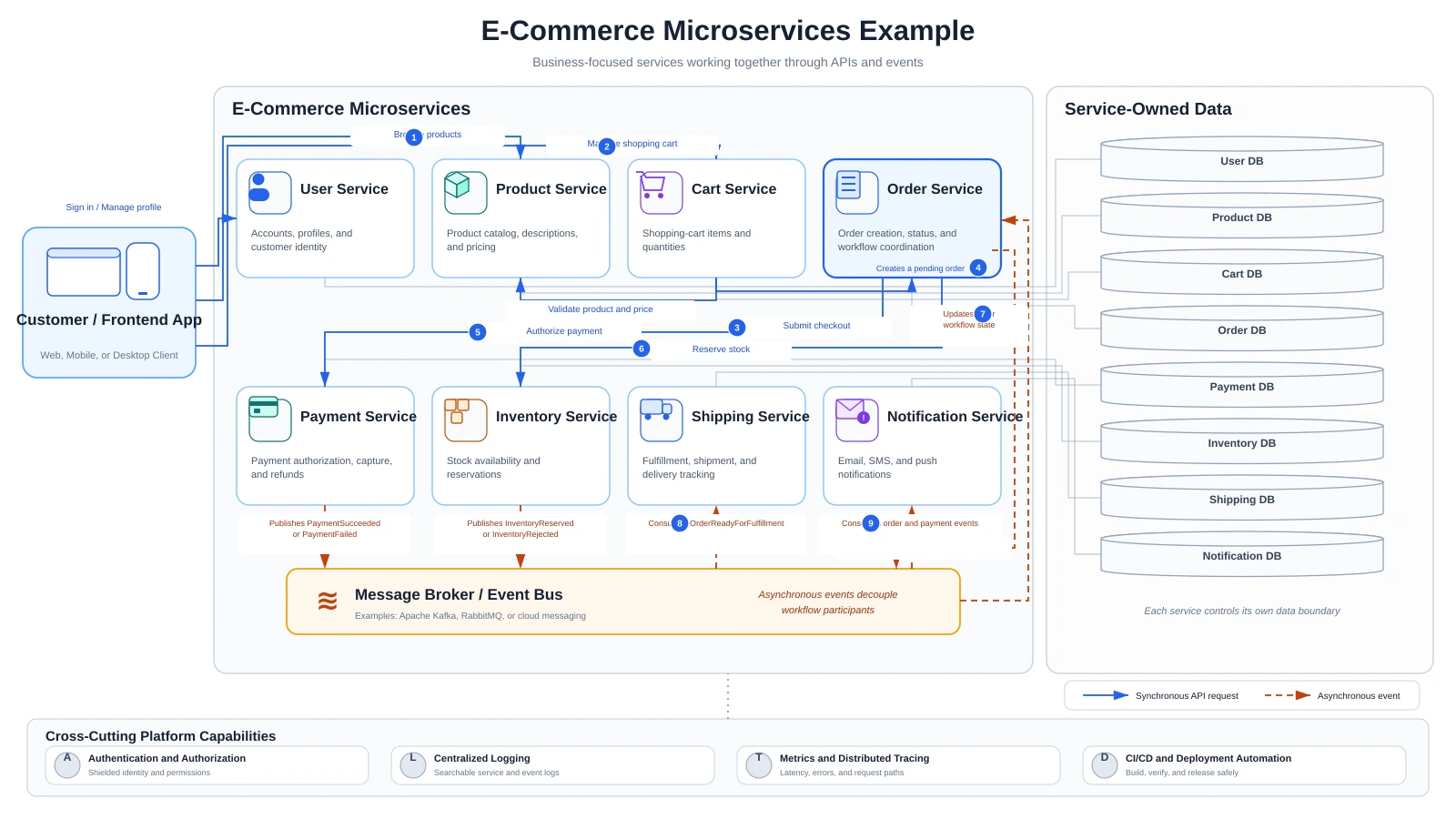
Example Request Flow: Placing an Order
A simplified checkout flow may work as follows:
- The customer adds products to the cart.
- Cart Service stores the selected items.
- The customer begins checkout.
- Order Service validates the request and creates an order with a pending status.
- Payment Service attempts to process the payment.
- Inventory Service reserves stock when the required conditions are met.
- Shipping Service creates fulfillment information only after the workflow allows it.
- Notification Service sends a final order confirmation only after payment and inventory succeed.
- If payment or inventory fails, the order remains pending, is cancelled, or enters a recovery workflow.
This example shows one benefit of microservices: each service owns a clearer responsibility.
It also reveals the difficulty of distributed systems.
For example:
- What happens if payment succeeds but inventory is unavailable?
- Should the payment be refunded automatically?
- What happens if Notification Service is unavailable?
- How are duplicate payment messages handled?
- Which service owns the final order status?
- What happens when a message arrives late?
Microservices provide flexibility, but they require deliberate workflow and failure-handling design.
Microservices vs Monolithic Architecture
The most common architectural comparison is microservices versus monolithic architecture.
A monolithic architecture builds and deploys the application primarily as one unit.
The code can still be organized into clean modules, layers, and business areas, but the application is commonly built and released together.
A microservices architecture divides the application into separately owned services that communicate through APIs or messages.
Neither style is always better.
The correct choice depends on:
- System size
- Domain complexity
- Team structure
- Release requirements
- Scaling needs
- Reliability requirements
- Operational maturity
- Infrastructure cost
For a deeper comparison, read Microservices vs Monolithic: Pros, Cons & Differences.
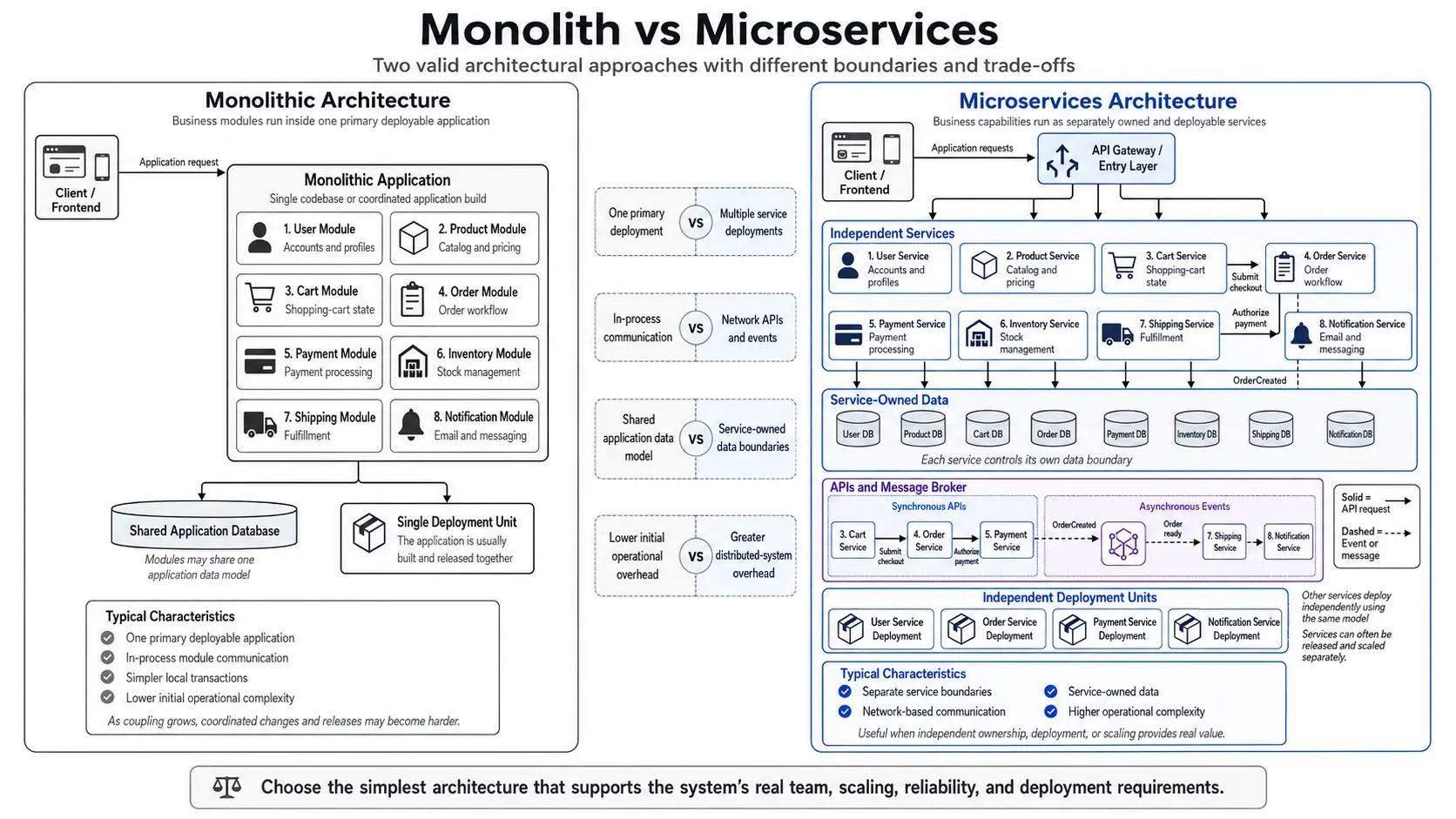
| Area | Monolithic Architecture | Microservices Architecture |
|---|---|---|
| Structure | One primary application | Multiple independently owned services |
| Deployment | Usually deployed as one unit | Services can often be deployed separately |
| Scaling | Commonly scales as one application | Individual services may scale independently |
| Team ownership | One or several teams work in the same application | Teams may own separate services |
| Data model | Often uses one shared database | Services control their own data boundaries |
| Debugging | Easier to trace inside one process | Harder because requests cross network boundaries |
| Best for | Small teams, MVPs, and simpler systems | Larger systems, multiple teams, and complex domains |
| Main risk | The application becomes difficult to change as coupling grows | Distributed-system and operational complexity |
A monolith can be modular, maintainable, and successful.
A microservices system can be tightly coupled and difficult to operate when its boundaries are poorly designed.
The goal is not to choose microservices because they sound modern. The goal is to choose the architecture that fits the real problem.
Main Characteristics of Microservices
Microservices commonly share several characteristics.
Organized Around Business Capabilities
A service should represent a meaningful business capability rather than a generic technical layer.
Good examples include:
- Order Service
- Payment Service
- Inventory Service
- Shipping Service
- User Service
Weak examples include:
- Controller Service
- Database Service
- Utility Service
- JSON Service
A useful question is:
What part of the business does this service own?
If that question cannot be answered clearly, the service boundary may be weak.
Independently Deployable
Independent deployment means a service can be changed and released without requiring the complete application to be deployed.
This is one of the main potential benefits of microservices.
However, simply placing services in separate repositories does not guarantee independent deployment.
Services may still be tightly coupled when:
- They must be released in a particular order.
- A small API change breaks several consumers.
- They share internal database tables.
- They depend on one another’s private data structures.
- One workflow requires every service to be available simultaneously.
Independent deployment requires stable contracts, clear ownership, automated testing, and compatible changes.
Loosely Coupled
Loose coupling means services minimize unnecessary dependencies.
A service should not depend on another service’s:
- Private source code
- Internal database tables
- Deployment process
- Unpublished data structures
- Implementation-specific behavior
For example, Order Service should not directly update Payment Service data.
It should ask Payment Service to perform a payment operation through a controlled API, command, or message.
Service-Owned Data
Each service should generally own and control its data boundary.
For example:
- User Service controls user-profile data.
- Order Service controls order data.
- Payment Service controls payment records.
- Inventory Service controls stock and reservation data.
This is commonly associated with the database-per-service pattern.
However, service-owned data does not always require a completely separate physical database server for every service.
Isolation may use:
- Separate databases
- Separate schemas
- Separate collections
- Controlled tables
- Other ownership boundaries appropriate to the system
The important principle is that one service should not freely modify another service’s private data.
Service-owned data improves independence but creates challenges involving reporting, transactions, synchronization, and eventual consistency.
Part of a Distributed System
A microservices application is a distributed system because its services communicate across network boundaries.
That means failures are normal.
For example:
- A service may respond slowly.
- A network request may time out.
- A dependency may be unavailable.
- A message may be delayed.
- A message may be delivered more than once.
- Services may temporarily disagree about data.
- A deployment may introduce an incompatible change.
Good microservices design assumes these situations will occur and defines how the system should respond.
Expert note: Microservices solve some ownership, deployment, and scaling problems, but they also introduce distributed-system problems. For small applications, a well-structured monolith is often the better starting point.
Common Components in a Microservices Architecture
Microservices architecture may contain many supporting components, but beginners should start with the fundamentals.
| Component | Simple Meaning | Beginner Example |
|---|---|---|
| Service | An application component that owns one business capability | Order Service creates and tracks orders |
| API | A contract used for communication | Order Service calls a Payment API |
| API Gateway or entry layer | A controlled entry point for client requests | Frontend sends requests to one gateway |
| Service-owned data | Data controlled by one service | Product Service controls product data |
| Message broker | Infrastructure that carries messages or events | OrderCreated is delivered to consumers |
| Service discovery | Helps applications locate service instances | Order Service finds a healthy Payment Service instance |
| Load balancing | Distributes traffic among instances | Requests are shared across three Order Service instances |
| Observability | Uses logs, metrics, and traces to explain system behavior | A trace shows why checkout was slow |
| CI/CD | Automates testing, building, and deployment | A pipeline deploys Payment Service safely |
| Resilience mechanisms | Control failures between distributed components | Timeouts, retries, and circuit breakers |
You do not need every possible component on the first day.
The important idea is that microservices require supporting architecture and operational practices. The services themselves are only one part of the system.
For more detail, read Microservices Architecture Components Explained With Examples.
The published API Gateway in Microservices Architecture Explained guide explores the client-entry layer in greater detail.
Future topics such as Service Discovery in Microservices Explained and Database per Service Pattern Explained will explore the other components without overloading this beginner article.
Advantages and Disadvantages of Microservices
Microservices have meaningful advantages and serious disadvantages.
A good architecture decision considers both.
| Topic | Potential Advantage | Trade-Off |
|---|---|---|
| Deployment | Services can be released independently | Many releases and pipelines must be managed safely |
| Scaling | High-traffic services can scale separately | Infrastructure and capacity planning become more complex |
| Team ownership | Teams can own capabilities from development through production | Poor boundaries can create coordination problems |
| Technology choice | A service may use specialized technology when justified | Too many technologies become difficult to maintain |
| Failure isolation | One failure may be contained | Network calls create additional failure points |
| Data ownership | Services control their own data boundaries | Cross-service consistency and reporting become harder |
| Development speed | Independent teams may release faster | Contract and workflow coordination remains necessary |
| Reliability | Noncritical services may fail without stopping the complete system | Reliability requires observability and deliberate failure handling |
| Cost | Resources can be allocated to specific workloads | Operational and infrastructure costs are usually higher |
Microservices are useful when these benefits are greater than their technical and operational costs.
When Should You Use Microservices?
Consider microservices when the application and organization have enough complexity to justify them.
Microservices may be appropriate when:
- Different parts of the system need to scale differently.
- Multiple teams own different business capabilities.
- Teams need independent release schedules.
- The domain contains clear service boundaries.
- Some capabilities require specialized security or reliability controls.
- The application has become difficult to deploy safely as one unit.
- The organization has strong testing, monitoring, and deployment automation.
- Independent ownership provides measurable business value.
| Situation | Consider Microservices? | Reason |
|---|---|---|
| Small MVP with one team | Usually no | A monolith is normally faster and simpler |
| Simple CRUD application | Usually no | Microservices may add complexity without meaningful benefit |
| Large application with several teams | Often | Teams may own and release capabilities independently |
| Different scaling requirements | Often | Specific services can receive additional resources |
| Unclear business boundaries | Not yet | Weak boundaries create a distributed monolith |
| No automated deployment or monitoring | Not yet | The operational foundation is missing |
| Growing monolith with clear modules | Possibly | Selected modules may become extraction candidates |
| High reliability requirements | Depends | Microservices may help, but only with strong design and operations |
A practical rule is:
Start with the simplest architecture that safely supports the current requirements, while keeping boundaries clean enough to evolve later.
Do not choose microservices only because you expect the product to grow.
Growth alone does not justify distributed architecture.
When Should You Avoid Microservices?
Avoid microservices when the system, team, or operational environment is not ready for the additional complexity.
Microservices may be the wrong choice when:
- You are building an early MVP.
- One small team owns the complete product.
- The application is mainly simple CRUD functionality.
- The domain is not yet understood.
- Service boundaries are unclear.
- Automated tests are weak.
- Deployment is manual and risky.
- Monitoring and logging are limited.
- All proposed services would share the same database.
- All proposed services must always be released together.
- Infrastructure cost needs to remain minimal.
- The main motivation is copying another company’s architecture.
A monolith is not a failure.
A modular monolith can provide:
- One simple deployment
- Easier local development
- Simpler testing
- Lower infrastructure cost
- Clear internal business modules
- A path for future service extraction
If one module later develops different scaling, ownership, security, or release requirements, it may become a candidate for extraction into a microservice.
Expert note: Many successful microservices systems began as simpler applications. Their teams learned the domain first and separated services when the correct boundaries became clearer.
Common Beginner Mistakes About Microservices
| Mistake | Why It Hurts | Better Approach |
|---|---|---|
| Splitting the system too early | Distributed complexity appears before the domain is understood | Begin with a monolith or modular monolith when appropriate |
| Creating too many tiny services | Every service adds deployment, testing, monitoring, and communication overhead | Design around meaningful business capabilities |
| Sharing one uncontrolled database | Services become tightly coupled through data access | Define and enforce service data ownership |
| Treating microservices as APIs only | APIs are interfaces, while services also require ownership and operational boundaries | Consider deployment, data, contracts, and responsibility |
| Assuming messaging guarantees resilience | Consumers can fail, duplicate messages can arrive, and queues can grow | Design retries, idempotency, dead-letter handling, and monitoring |
| Ignoring observability | Failures become difficult to trace across services | Add logs, metrics, identifiers, and tracing as needed |
| Copying large companies blindly | Their traffic, teams, and constraints may not match yours | Choose architecture based on your own requirements |
| Using different technology everywhere | Operational and maintenance costs increase | Standardize unless a different tool solves a real problem |
| Calling every small function a service | The system becomes fragmented and slow | Keep meaningful operations together |
| Treating Kubernetes as the architecture | Infrastructure cannot create good business boundaries | Design the domain and contracts before choosing deployment tools |
The most damaging mistake is separating the system before understanding the business boundaries.
Poor boundaries lead to:
- Excessive service-to-service calls
- Shared data dependencies
- Coordinated deployments
- Inconsistent business rules
- Difficult workflows
- Unclear ownership
Future articles such as Microservices Design Principles Explained and How to Define Service Boundaries in Microservices will explore these decisions in more detail.
Microservices Best Practices for Beginners
If you are learning microservices, focus on architectural principles before tools.
You do not need to begin with Kubernetes, service mesh, Saga, CQRS, or multi-region deployment.
Those subjects are useful when they solve actual problems, but they are not the foundation.
Start With Business Capabilities
A service should represent a business capability, such as:
- Orders
- Payments
- Users
- Inventory
- Shipping
- Notifications
Avoid splitting the system only by technical layers such as controllers, repositories, or utility functions.
Keep Services Loosely Coupled
Services should communicate through clear contracts.
A service should not depend on another service’s:
- Private code
- Database tables
- Internal classes
- Deployment schedule
- Unpublished behavior
Loose coupling makes it easier to change one service without breaking the rest of the system.
Make Data Ownership Explicit
Define which service controls each data set.
Avoid allowing several services to update the same private tables directly.
When another service needs the data, use an API, event, replicated read model, or another controlled mechanism.
Avoid Distributed Complexity Too Early
If the application is simple, a monolith may be the better design.
If the team is small, microservices may create more operational work than business value.
Use microservices only when their advantages justify their cost.
Automate Testing and Deployment
Independent deployment becomes difficult when releases are manual.
Each service should eventually have a repeatable process to:
- Build
- Test
- Package
- Deploy
- Verify
- Roll back or roll forward
Monitor Service Health
A request may pass through several services.
Use appropriate observability tools to understand:
- Request rates
- Error rates
- Latency
- Queue depth
- Dependency failures
- Service health
- Distributed request paths
Design for Failure
Assume that:
- Requests can time out.
- Dependencies can fail.
- Messages can be duplicated.
- Events can arrive late.
- Consumers can fall behind.
- Services can temporarily disagree about state.
Define what should happen in each important failure case.
Keep the Number of Services Manageable
More services do not automatically create better architecture.
A small number of well-designed services is better than dozens of tiny services with unclear responsibilities.
Document Service Contracts
Document:
- API endpoints
- Input and output schemas
- Error responses
- Event names
- Message schemas
- Compatibility expectations
- Timeout behavior
- Ownership
Learn the Basics Before Advanced Patterns
Begin with:
- Service ownership
- API communication
- Events and messages
- Independent deployment
- Data ownership
- Loose coupling
- Service boundaries
- Monitoring and failure handling
Then study advanced subjects when you understand the problems they solve.
How to Continue Learning Microservices
A structured learning path prevents microservices from becoming overwhelming.
A practical order is:
- Understand what microservices are.
- Learn how a basic request flows through a service-based system.
- Compare microservices with monolithic architecture.
- Learn the main components of microservices architecture.
- Study API Gateways, service discovery, and data ownership.
- Learn how to define service boundaries.
- Study synchronous and asynchronous communication.
- Learn event-driven workflows and consistency.
- Study deployment, testing, observability, and reliability.
- Learn advanced patterns only when the fundamentals are clear.
Recommended next articles:
- Microservices Architecture Diagram Explained + Examples for visual request and event flows.
- Microservices Architecture Components Explained With Examples for gateways, discovery, messaging, data, security, and observability.
- Microservices vs Monolithic: Pros, Cons & Differences for architecture trade-offs.
- API Gateway in Microservices Architecture Explained for client routing and edge concerns.
Future topics such as Service Discovery in Microservices Explained, Database per Service Pattern Explained, and Microservices Learning Roadmap for Beginners can provide the next layer of detail.
Frequently Asked Questions About Microservices
What Are Microservices in Simple Terms?
Microservices are a way to build one application as several independently owned services.
Each service handles a meaningful business function, such as users, orders, payments, inventory, or notifications.
What Is a Microservice?
A microservice is a software service that owns one business capability and communicates with other parts of the application through defined contracts.
For example, Order Service creates and tracks orders, while Payment Service manages payment attempts and refunds.
What Is a Common Microservices Example?
An e-commerce platform is a common microservices example.
It may contain separate services for users, products, carts, orders, payments, inventory, shipping, and notifications.
How Do Microservices Work?
Microservices work by communicating through APIs, events, commands, or messages.
Each service owns a particular responsibility and collaborates with other services when a business workflow requires it.
Are Microservices Better Than Monolithic Architecture?
Not always.
Microservices can help large systems and multiple teams work more independently, but monolithic architecture is often simpler, faster, and less expensive for small teams and early products.
When Should I Use Microservices?
Consider microservices when the application has clear business boundaries, multiple teams need independent ownership, different capabilities have different scaling requirements, and the organization can support automated deployment, monitoring, and distributed failure handling.
When Should I Avoid Microservices?
Avoid microservices when building a small MVP, working with one small team, developing a simple application, or operating without strong testing, monitoring, and deployment practices.
What Is the Difference Between an API and a Microservice?
An API is a communication interface.
A microservice is an independently owned software component responsible for a business capability.
A microservice may expose one or more APIs, but an API by itself is not necessarily a microservice.
Does Every Microservice Need Its Own Database?
Not necessarily.
Each service should generally own and control its data boundary, but that does not always require a completely separate physical database server.
Isolation may use separate databases, schemas, collections, or other controlled mechanisms.
Do Microservices Require Docker or Kubernetes?
No.
Docker and Kubernetes can help package and operate services, but they are deployment tools rather than requirements of the architectural style.
Microservices can run using many different deployment approaches.
Are Microservices Good for Beginners?
Microservices are useful for beginners to study as an architectural concept.
However, they are not always the best architecture for a beginner’s first application. It is helpful to understand monoliths, APIs, databases, testing, and deployment before building a complex distributed system.
What Are the Main Parts of Microservices Architecture?
Common parts include:
- Independently owned services
- APIs and service contracts
- An API Gateway or another entry layer
- Service-owned data
- Service discovery where needed
- Load balancing
- Message brokers
- Authentication and authorization
- Logs, metrics, and traces
- Configuration and secrets management
- CI/CD
- Resilience mechanisms
The exact components depend on the system’s requirements.
Conclusion
Microservices are an architectural style for building one application as a set of independently owned services.
Each service controls a meaningful business capability and communicates with other services through APIs, events, commands, or messages.
The simplest answer to “what are microservices?” is:
Microservices divide an application into services that can often be developed, deployed, operated, and scaled more independently.
That independence can be valuable, but it is not free.
Microservices also introduce:
- Network failures
- Distributed data
- Eventual consistency
- Harder debugging
- More deployments
- Additional monitoring
- More complex testing
- Higher operational cost
For beginners, the right approach is not to start with Kubernetes, service mesh, or advanced patterns.
Start with:
- Clear service responsibilities
- Business-aligned boundaries
- Loose coupling
- Explicit data ownership
- Stable communication contracts
- Reliable deployment
- Observability
- Practical trade-offs
Continue by reading Microservices Architecture Diagram Explained + Examples, followed by Microservices Architecture Components Explained With Examples, and then Microservices vs Monolithic: Pros, Cons & Differences.