Microservices architecture components are the building blocks that allow independently deployable services to operate together as one distributed application.
These components include business services, APIs, entry layers, service discovery, service-owned data, asynchronous messaging, security, observability, deployment automation, and resilience controls.
Microservices architecture is not simply the practice of splitting an application into many small services. A production system also needs supporting components and operational practices that help those services communicate, locate healthy instances, protect data, deploy safely, and recover from partial failures.
Without those foundations, a microservices system can become more difficult to maintain than a well-structured modular monolith.
If you are new to the architecture, begin with What Are Microservices? A Simple Explanation for Beginners.
This guide explains:
- What each microservices component does
- Why each component matters
- When you may need it
- When it may be unnecessary
- How the components work together
- Which components are foundational
- Which components should be introduced only when complexity justifies them
Quick answer: The 15 main components of microservices architecture are independent services, APIs and service contracts, an API Gateway or entry layer, service discovery, a service registry, load balancing, service-owned data, a message broker or event bus, a service mesh, authentication and authorization, observability, configuration and secrets management, containers and orchestration, CI/CD, and resilience mechanisms.
Microservices Architecture Components Diagram
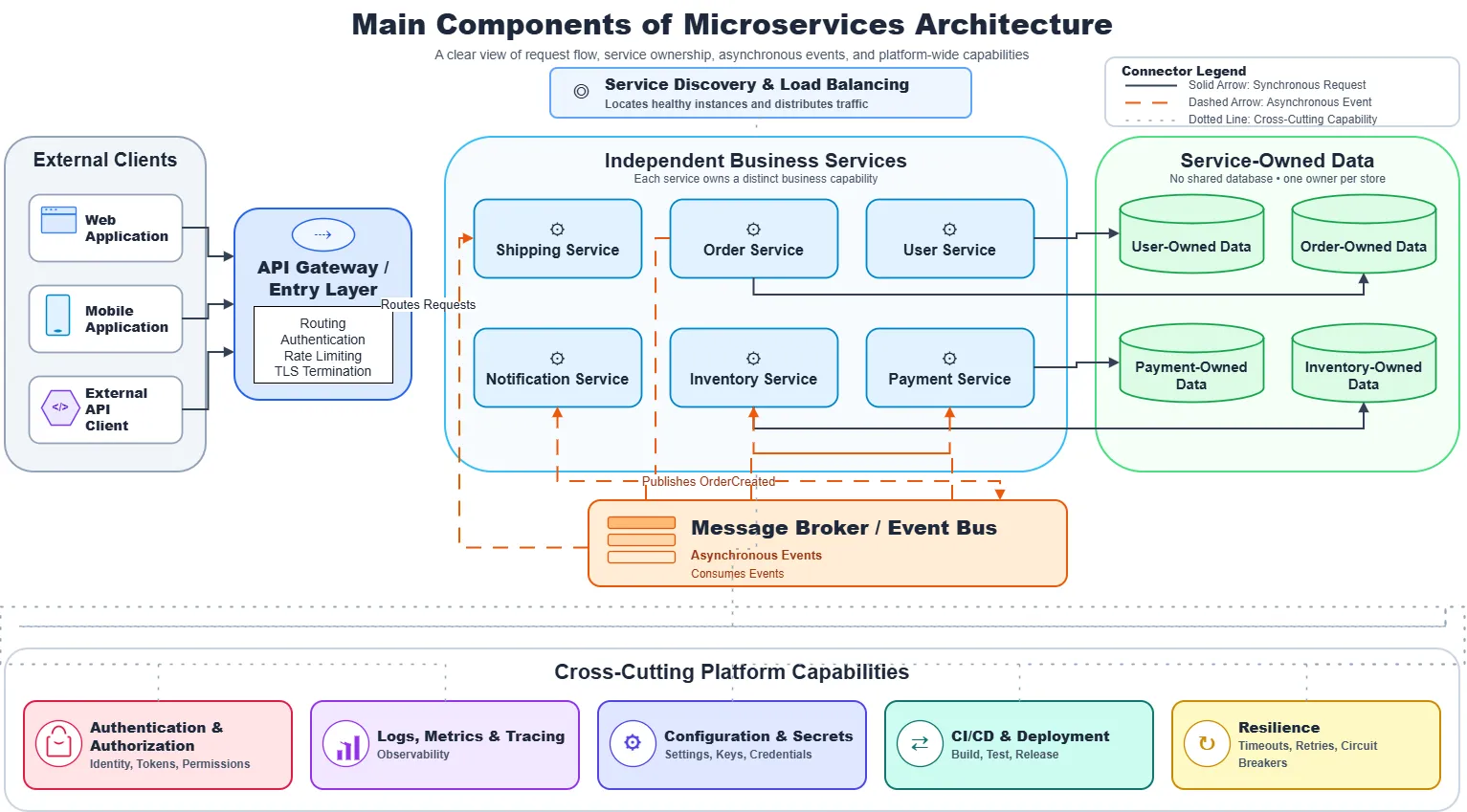
A typical microservices architecture may include:
- External clients
- An API Gateway or another entry layer
- Multiple independently owned business services
- Synchronous APIs
- Asynchronous messaging
- Service discovery and load balancing
- Service-owned data
- Authentication and authorization
- Logs, metrics, and distributed traces
- Configuration and secrets management
- CI/CD and deployment infrastructure
- Resilience mechanisms
The diagram shows that microservices are not isolated pieces of code. They operate as part of a distributed system in which every supporting component has a specific responsibility.
What Are Microservices Architecture Components?
Microservices architecture components are the services, communication mechanisms, data boundaries, infrastructure systems, and operational controls that allow independently owned services to function as one application.
A microservice normally owns a specific business capability, such as:
- User accounts
- Product catalog
- Orders
- Payments
- Inventory
- Shipping
- Notifications
Supporting components help those services:
- Receive and route requests
- Locate healthy service instances
- Communicate through APIs or events
- Protect their data boundaries
- Authenticate users and services
- Enforce permissions
- Store configuration and secrets
- Detect failures and performance problems
- Build and deploy changes safely
- Prevent one failure from spreading across the system
Not every system needs every component from the beginning.
Some components are foundational. Others become important when the system enters production or grows in scale. Advanced infrastructure should be introduced only when it solves a real technical or operational problem.
The 15 Main Components of Microservices Architecture
| Component | Main Responsibility | Simple Example | Typical Priority |
|---|---|---|---|
| Independent services | Own business capabilities | Order Service | Foundational |
| APIs and service contracts | Define communication boundaries | POST /orders | Foundational |
| API Gateway or entry layer | Controls external entry and routing | Mobile app calls one gateway | Conditional but common |
| Service discovery | Locates healthy service instances | Order Service finds Payment Service | Dynamic environments |
| Service registry | Stores service-instance information | Consul or platform registry | Implementation-dependent |
| Load balancing | Distributes traffic across instances | Requests shared across Order Service replicas | Scaling and availability |
| Service-owned data | Protects service data boundaries | Order-owned and Payment-owned data | Foundational |
| Message broker or event bus | Enables asynchronous communication | OrderCreated event | Conditional |
| Service mesh | Manages complex internal traffic | Mutual TLS and traffic policies | Advanced |
| Authentication and authorization | Protects identities and operations | Token validation and permission checks | Production baseline |
| Observability | Exposes system behavior | Logs, metrics, and traces | Production baseline |
| Configuration and secrets | Manages settings and credentials | API key stored in a secrets manager | Production baseline |
| Containers and orchestration | Packages and operates services | Docker and Kubernetes | Conditional |
| CI/CD pipeline | Automates testing and deployment | GitHub Actions deployment | Production baseline |
| Resilience mechanisms | Control distributed failures | Timeout, retry, and circuit breaker | Production baseline |
The goal is not to select the largest possible technology stack.
A good architecture begins with clear business boundaries and adds infrastructure only when the system’s requirements justify it.
1. Independent Microservices
Independent services are the central building blocks of microservices architecture.
Each service should own a meaningful business capability rather than a generic technical layer.
Good service examples include:
- User Service for user accounts and profiles
- Order Service for creating and tracking orders
- Payment Service for payment attempts and refunds
- Inventory Service for stock availability and reservations
- Shipping Service for fulfillment and delivery
- Notification Service for email, SMS, and push messages
Weak service boundaries include names such as:
- Controller Service
- Database Service
- Utility Service
- Validation Service
- JSON Service
These names usually describe implementation details rather than business responsibilities.
A well-designed service should have:
- A clearly defined business responsibility
- An owned API or event contract
- Clear data ownership
- A team or group responsible for it
- Limited dependence on other services’ internal details
- An independent deployment boundary when that independence provides value
A microservice does not need to be extremely small. It should be small enough to understand and own, but large enough to represent a meaningful business capability.
A useful design concept is a bounded context. A bounded context defines where a business model and its terminology apply.
For example:
- Order Service owns the meaning and lifecycle of an order.
- Payment Service owns authorizations, captures, failures, and refunds.
- Shipping Service owns fulfillment and delivery status.
Common mistake: Splitting a system by technical layers can create a distributed monolith. Define services around business capabilities instead of controllers, databases, or utility classes.
2. APIs and Service Contracts
APIs and service contracts define how clients and services communicate.
A service should expose a controlled interface instead of allowing consumers to depend on its internal code or database structure.
Common synchronous communication styles include:
- REST over HTTP
- gRPC
- GraphQL at a client-facing layer
- Messaging-based request and response where appropriate
For example, Order Service may expose:
POST /orders
GET /orders/{orderId}
GET /orders/{orderId}/status
The contract should define:
- Accepted input
- Returned output
- Authentication requirements
- Authorization expectations
- Error responses
- Versioning behavior
- Timeout expectations
- Compatibility rules
Consumers should be able to use the contract without knowing how Order Service stores or processes its data.
A stable contract protects the boundary between services. It also allows a service’s internal implementation to change while its external behavior remains compatible.
APIs Are Not the Same as Microservices
An API is an interface.
A microservice is an independently owned software component responsible for a business capability.
A microservice may expose one or more APIs, but an API by itself is not automatically a microservice.
Avoid Hidden Coupling
Services can remain tightly coupled even when they communicate through HTTP.
Hidden coupling exists when:
- One service depends on another service’s private field names.
- Services must be deployed in a specific sequence.
- A small API change breaks many consumers.
- One request requires a long chain of synchronous calls.
- Several services directly access the same internal tables.
Stable contracts, compatibility testing, versioning, and clear ownership help reduce this coupling.
3. API Gateway or Client Entry Layer
An API Gateway is a common entry point between external clients and internal services.
Instead of requiring a web application or mobile app to call every internal service directly, the client sends requests to the gateway. The gateway routes each request to the appropriate service.
For example:
/api/users    → User Service
/api/products → Product Service
/api/orders   → Order Service
/api/payments → Payment Service
An API Gateway may handle:
- Request routing
- Access-token validation
- Basic authorization checks
- TLS termination
- Rate limiting
- Access logging
- API versioning
- Request transformation
- Response aggregation
- Correlation identifiers
- Client-specific routing
The gateway should remain focused on edge-level concerns.
It should not own:
- Order calculations
- Payment approval decisions
- Inventory reservation rules
- Customer records
- Service databases
- Core domain workflows
Those responsibilities belong inside the services that own the corresponding business capabilities.
For a deeper explanation, read API Gateway in Microservices Architecture Explained.
Is an API Gateway Always Required?
No.
A small internal system with only a few services may not need a dedicated API Gateway.
Other entry mechanisms include:
- An ingress controller
- A backend-for-frontend service
- A reverse proxy
- A platform-managed gateway
- Limited direct service access for internal clients
The architecture should represent the real entry mechanism instead of including an API Gateway only because it appears in popular diagrams.
4. Service Discovery
Service discovery allows software to locate healthy service instances at runtime.
In a dynamic environment, service locations can change because instances may:
- Restart
- Move to another host
- Scale up or down
- Become unhealthy
- Be replaced during deployment
- Run across different zones or nodes
Hardcoding a service IP address is fragile in this environment.
For example, Order Service may need to contact Payment Service. Instead of depending on one fixed address, it uses a service name or discovery mechanism to locate a healthy instance.
Service discovery becomes useful when:
- Multiple instances of a service are running
- Containers restart frequently
- Services move between hosts
- Automatic scaling is enabled
- Health checks determine routing
- Static configuration is difficult to maintain
Client-Side Discovery
With client-side discovery:
- The calling service requests available instances.
- The registry or platform returns healthy locations.
- The calling service selects an instance.
- The request is sent directly to that instance.
Server-Side Discovery
With server-side discovery:
- The calling service sends a request to a router or load balancer.
- The routing layer uses service-location information.
- The request is forwarded to a healthy instance.
Many orchestration and cloud platforms provide discovery through internal DNS or managed service abstractions.
A separate discovery product is not always necessary.
5. Service Registry
A service registry stores or exposes information about available service instances.
The stored information may include:
- Service name
- Hostname or IP address
- Port
- Health status
- Availability zone
- Version
- Metadata
- Registration time
A registry may be maintained through:
- Self-registration by services
- Platform-managed registration
- Health checks
- Orchestration infrastructure
- External discovery agents
Technologies associated with service registries include:
- Consul
- Eureka
- etcd
- Kubernetes Services and internal DNS
- Cloud-native discovery platforms
The difference between service discovery and a service registry is straightforward:
| Concept | Responsibility |
|---|---|
| Service registry | Stores or exposes information about available service instances |
| Service discovery | Uses that information to locate an appropriate instance |
A useful analogy is:
- The registry is the directory.
- Discovery is the lookup process.
Not every architecture has a visible standalone registry. The platform may provide registry behavior automatically.
6. Load Balancing
A load balancer distributes traffic across multiple service instances.
If three Order Service instances are running, the load balancer can distribute requests among them instead of sending every request to one instance.
Load balancing can improve:
- Availability
- Capacity
- Fault tolerance
- Resource usage
- Response time under load
Load balancing may occur:
- Between clients and gateway instances
- Between the gateway and backend services
- Between internal services
- Inside a container platform
- At the cloud-provider network layer
- Through a service mesh
Service discovery and load balancing often work together:
- Discovery identifies healthy instances.
- Load balancing selects an instance for the request.
Common balancing strategies include:
- Round robin
- Least active connections
- Weighted routing
- Response-time-based routing
- Geographic routing
- Health-aware routing
A load balancer does not replace timeouts, retries, capacity planning, or good service boundaries. It controls traffic distribution, not the complete failure-handling strategy.
7. Service-Owned Data and Database per Service
A central microservices principle is that each service should own and control its data boundary.
This is commonly described as the database-per-service pattern, although it does not always require one physical database server for every service.
Data isolation may use:
- Separate physical databases
- Separate database instances
- Separate schemas
- Separate collections
- Dedicated tables with enforced ownership
- Other controlled storage boundaries
For example:
- User Service controls user data.
- Order Service controls order data.
- Payment Service controls payment data.
- Inventory Service controls inventory data.
Payment Service should not directly update Order Service tables.
When Payment Service needs order information, it should normally use:
- An Order Service API
- An event published by Order Service
- A replicated read model
- A controlled synchronization process
Service-owned data supports:
- Clear ownership
- Independent schema changes
- Reduced coupling
- Team autonomy
- Better enforcement of domain rules
- Independent storage decisions where justified
However, the pattern also creates trade-offs:
- Cross-service reporting becomes harder.
- Distributed transactions require different approaches.
- Data consistency must be designed explicitly.
- Joins across business domains are more difficult.
- Reconciliation and migration require planning.
The objective is not to create as many databases as possible.
The objective is to prevent services from becoming coupled through uncontrolled shared-data access.
8. Message Broker or Event Bus
A message broker or event bus supports asynchronous communication between services.
In synchronous communication, one service sends a request and waits for a response.
In asynchronous communication, a service publishes a message or event, and consumers process it independently.
For example:
- Order Service creates an order with a pending status.
- Order Service publishes an
OrderCreatedevent. - Payment Service consumes the event and begins payment processing.
- Shipping Service may create a pending fulfillment record.
- Notification Service sends an order-received or payment-pending message.
- Later events determine whether the order is confirmed, cancelled, shipped, or refunded.
Order Service does not need to call every consumer directly.
Common messaging technologies include:
- Apache Kafka
- RabbitMQ
- Amazon SQS
- Amazon SNS
- Google Cloud Pub/Sub
- Azure Service Bus
- Redis Streams
- NATS
Message brokers can support:
- Background processing
- Traffic buffering
- Event-driven workflows
- Reduced temporal coupling
- Multiple independent consumers
- Retry processing
- Integration between services
Messaging does not automatically make a system reliable.
Reliable message processing also requires:
- Idempotent consumers
- Controlled retry policies
- Dead-letter handling
- Duplicate-message handling
- Message-ordering decisions
- Schema compatibility
- Monitoring and alerting
- Clear event ownership
Event Versus Command
An event describes something that already happened:
OrderCreated
PaymentSucceeded
InventoryReserved
A command asks a component to perform an action:
ProcessPayment
ReserveInventory
CancelOrder
Clear event and command names make distributed workflows easier to understand and operate.
9. Service Mesh
A service mesh is an infrastructure layer for managing service-to-service communication.
It is generally introduced when internal traffic has become difficult to secure, observe, or control consistently.
A service mesh may provide:
- Mutual TLS
- Service identity
- Traffic policies
- Retries and timeouts
- Traffic splitting
- Canary routing
- Telemetry
- Service-to-service access policies
- Internal traffic encryption
Service mesh implementations may use:
- Sidecar proxies
- Node-level proxies
- Platform-level networking components
- Ambient or sidecarless approaches
Examples include Istio and Linkerd.
Important: A service mesh is not required to build microservices.
It introduces operational complexity of its own.
A smaller system should normally begin with:
- Clear communication contracts
- Appropriate timeouts
- Basic service authentication
- Useful logs and metrics
- Simple routing
Introduce a service mesh only when it solves a measurable traffic-management, security, or observability problem.
10. Authentication and Authorization
Security is part of the architecture, not a feature that should be added after the system is complete.
Authentication answers:
Who is making this request?
Authorization answers:
What is this identity allowed to do?
A microservices system may use:
- An identity provider
- OAuth 2.0
- OpenID Connect
- Access tokens
- Service identities
- Role-based access control
- Attribute-based policies
- Mutual TLS
- Secrets management
An API Gateway may validate an access token before forwarding a request.
However, business authorization should remain close to the service that owns the operation.
For example:
- The gateway verifies that the token is valid.
- Order Service verifies whether the user may view a specific order.
- Payment Service enforces payment-related permissions.
- Administrative operations require appropriate roles or claims.
Internal services should not blindly trust every request simply because it originated inside the network.
A strong security design considers:
- User-to-service authentication
- Service-to-service authentication
- Least-privilege permissions
- Secret rotation
- Audit logging
- Encryption in transit
- Sensitive-data protection
- Authorization at the domain boundary
11. Observability: Logs, Metrics, and Distributed Tracing
Observability helps teams understand what a distributed system is doing.
A single request may pass through:
API Gateway
→ Order Service
→ Payment Service
→ Inventory Service
→ Notification Service
Without observability, identifying where a failure or delay occurred becomes difficult.
The three primary observability signals are:
| Signal | What It Shows | Example |
|---|---|---|
| Logs | Discrete events inside a service | Payment request rejected |
| Metrics | Numeric behavior over time | Error rate, latency, or queue depth |
| Traces | The path of distributed work | Checkout request across multiple services |
Logs
Useful structured logs may include:
- Timestamp
- Service name
- Environment
- Request or trace identifier
- Event name
- Error details
- Relevant business identifiers where safe
Passwords, access tokens, payment information, and other sensitive values should not be logged.
Metrics
Useful metrics may include:
- Request rate
- Error rate
- Response latency
- Queue depth
- Consumer lag
- CPU and memory usage
- Database connection usage
- Retry count
- Circuit-breaker state
Metrics become most useful when they are connected to dashboards, service objectives, and actionable alerts.
Distributed Tracing
Distributed tracing follows work across service boundaries.
A trace can show:
- Which services were called
- How long each operation took
- Where an error occurred
- Which dependency caused latency
- How synchronous and asynchronous work is connected
Observability should be introduced before the system becomes too distributed to debug effectively.
12. Configuration and Secrets Management
Services normally need different settings for development, testing, staging, and production.
Configuration may include:
- Environment names
- Service endpoints
- Database connection settings
- Timeout values
- Feature flags
- Logging levels
- Retry limits
- Queue names
Secrets may include:
- Passwords
- API keys
- Access tokens
- Private keys
- Database credentials
- Signing keys
Configuration and secrets are related, but they are not the same.
Ordinary configuration may be visible to application operators. Secrets require stronger access controls, limited exposure, and secure storage.
Avoid:
- Hardcoding production secrets in source code
- Committing secrets to Git
- Sharing one credential across every service
- Logging sensitive values
- Keeping credentials indefinitely
- Giving every service access to every secret
Common approaches include:
- Cloud secrets managers
- HashiCorp Vault
- Protected Kubernetes Secrets
- Encrypted deployment variables
- Managed service identities
- External configuration services
Each service should receive only the configuration and credentials it actually needs.
13. Containers and Orchestration
Containers package a service with its runtime and dependencies.
Docker is a common container technology, but microservices do not require containers.
Containers can provide consistency across:
- Development
- Automated testing
- Staging
- Production
A container image may include:
- The application
- Runtime
- Libraries
- Startup configuration
- Health-check behavior
Orchestration platforms operate service instances at scale.
An orchestration platform may:
- Start and stop containers
- Restart failed instances
- Perform health checks
- Scale services
- Schedule workloads
- Support rolling deployments
- Provide internal networking
- Manage configuration
- Route traffic
Kubernetes is a widely used orchestration platform, but Kubernetes is not the architecture itself.
A weak service design does not become a good microservices architecture simply because it runs on Kubernetes.
Architecture begins with:
- Business boundaries
- Contracts
- Data ownership
- Communication choices
- Security
- Failure handling
Containers and orchestration operate that architecture.
14. CI/CD Pipeline
CI/CD automates how software is tested, built, and delivered.
CI means Continuous Integration.
CD may mean Continuous Delivery or Continuous Deployment.
A typical service pipeline may:
- Receive a code change.
- Run formatting and static checks.
- Run unit tests.
- Run contract or integration tests.
- Build a deployable artifact or container image.
- Run dependency and security checks.
- Publish the versioned artifact.
- Deploy it to a test environment.
- Run automated verification.
- Promote or deploy the release.
- Monitor the new version.
- Roll back or roll forward when necessary.
CI/CD is especially valuable in microservices because independently owned services may change and deploy at different times.
Without automation, a system containing many services can create:
- Slow releases
- Manual errors
- Inconsistent environments
- Difficult rollbacks
- Deployment bottlenecks
- Fear of frequent changes
CI/CD should be supported by:
- Automated tests
- Versioned artifacts
- Deployment health checks
- Observability
- Compatible contracts
- Rollback or roll-forward strategies
- Clear service ownership
15. Resilience Mechanisms
Distributed systems can fail in many ways.
A dependency may:
- Respond slowly
- Time out
- Reject a request
- Restart
- Become overloaded
- Return an invalid response
- Lose network connectivity
- Process a message more than once
Resilience mechanisms help control those failures.
| Mechanism | Purpose |
|---|---|
| Timeout | Prevents a service from waiting indefinitely |
| Retry | Repeats a failed operation under controlled conditions |
| Circuit breaker | Temporarily stops calls to a failing dependency |
| Bulkhead | Separates resources to contain failures |
| Rate limiting | Protects services from excessive traffic |
| Fallback | Provides reduced behavior when a dependency is unavailable |
| Idempotency | Makes repeated processing safe |
| Dead-letter queue | Stores messages that cannot be processed |
| Backpressure | Controls work when consumers are overloaded |
Retries Must Be Controlled
Retries can help with temporary failures, but uncontrolled retries can make an outage worse.
A safe retry strategy may include:
- A maximum attempt count
- Exponential backoff
- Randomized jitter
- Retryable-error classification
- Idempotent operations
- An overall timeout limit
For example, if Payment Service becomes unavailable, Order Service should not wait indefinitely.
The system may:
- Keep the order in a pending-payment state.
- Retry through a controlled process.
- Inform the customer that payment is still processing.
- Cancel or expire the order if payment cannot complete.
The correct behavior depends on the business process and consistency requirements.
When Do You Need Each Component?
A common mistake is assuming that every microservices project must immediately include Kafka, Kubernetes, a service mesh, distributed tracing, and multiple databases.
That approach often creates unnecessary complexity.
A better approach is to introduce components when they solve real problems.
| Component | You Need It When | You May Not Need It Yet When |
|---|---|---|
| API Gateway | Multiple external clients require controlled access to several services | One internal client calls one simple backend |
| Service discovery | Instances move, restart, or scale dynamically | Services use stable locations in a small environment |
| Service registry | Runtime instance locations must be tracked | The platform provides discovery automatically |
| Load balancing | Multiple instances handle the same workload | A service has one low-traffic instance |
| Service-owned data | Services require independent ownership and evolution | The application is still a modular monolith |
| Message broker | Work can happen asynchronously or multiple consumers need the same event | Every operation genuinely requires an immediate response |
| Service mesh | Internal traffic and security policies have become difficult to manage | The system has only a few services |
| Distributed tracing | Requests cross several services | The system contains one or two simple components |
| Containers | Consistent packaging solves real deployment problems | The runtime platform deploys applications directly |
| Orchestration | Automated scheduling, scaling, and recovery are required | The application is a small prototype |
| CI/CD | Services are released frequently | The system is a temporary experiment |
| Advanced resilience | Dependency and failure behavior has become complex | Communication remains limited and well understood |
The best architecture is the smallest architecture that safely satisfies current requirements while leaving room to evolve.
Foundational, Production, Conditional, and Advanced Components
| Priority | Components | Guidance |
|---|---|---|
| Foundational | Business boundaries, contracts, service-owned data, security model, logs, and timeouts | Design these from the beginning |
| Production baseline | CI/CD, health checks, monitoring, secrets management, controlled retries, and deployment verification | Add before depending on the system in production |
| Conditional | API Gateway, discovery, message broker, containers, orchestration, and distributed tracing | Add when the architecture requires them |
| Advanced | Service mesh, multi-cluster routing, complex traffic policies, and advanced event infrastructure | Introduce only when scale or operational pain justifies them |
This classification is more useful than labeling every component as universally required.
How the Components Work Together: E-Commerce Example
An e-commerce checkout demonstrates how client traffic, business services, data ownership, messaging, security, observability, and failure handling work together.
Imagine an application containing:
- User Service
- Catalog Service
- Cart Service
- Inventory Service
- Order Service
- Payment Service
- Shipping Service
- Notification Service
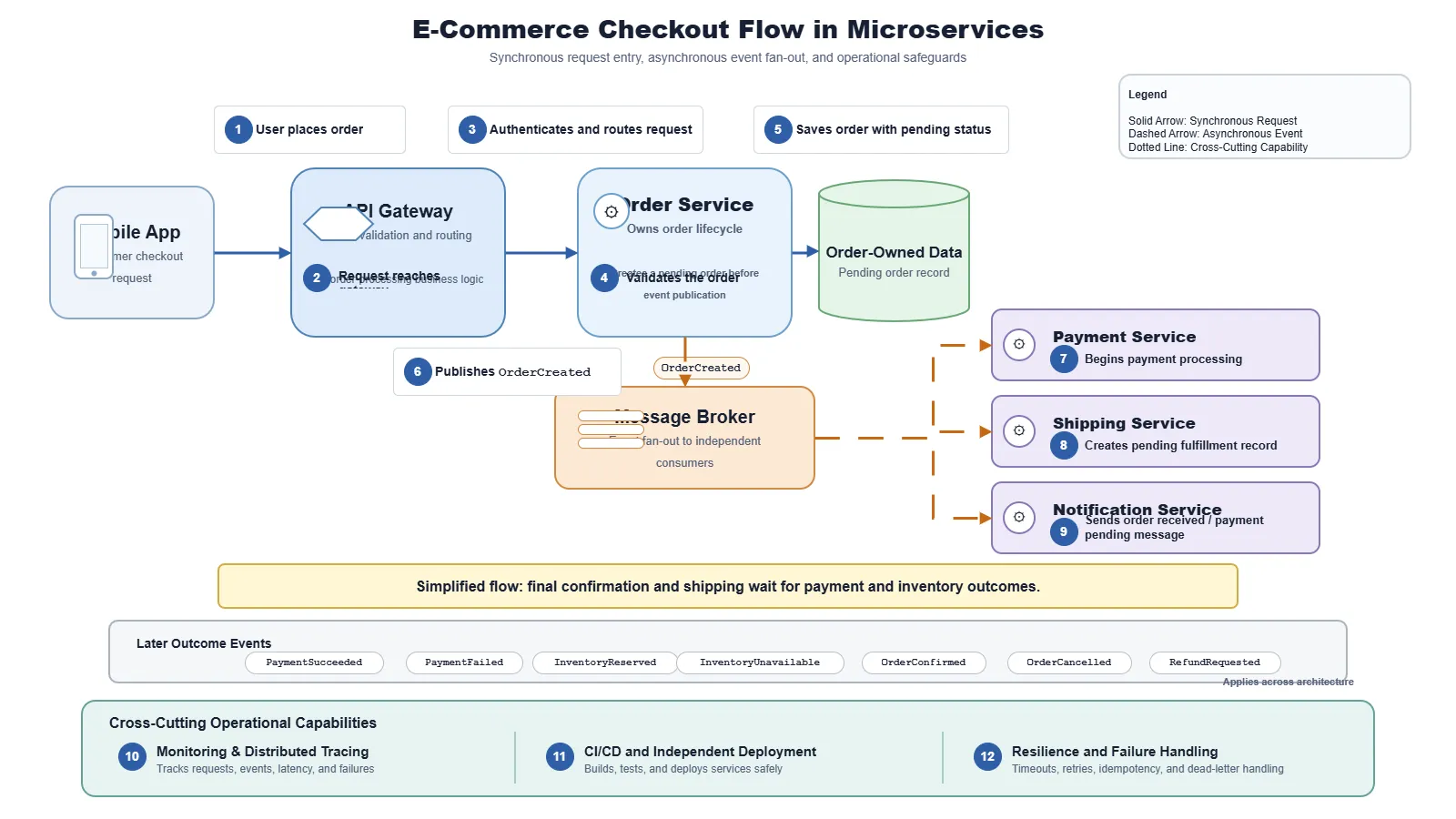
A simplified checkout flow may work as follows:
- The customer places an order from the mobile application.
- The request reaches the API Gateway.
- The gateway validates the customer’s access token and routes the request to Order Service.
- Order Service validates the order request.
- Order Service stores the order with a pending status in its owned data store.
- Order Service publishes an
OrderCreatedevent. - Payment Service consumes the event and begins payment processing.
- Shipping Service may create a pending fulfillment record, but it does not ship the order.
- Notification Service sends an order-received or payment-pending message.
- Monitoring and distributed tracing follow the request and event flow.
- CI/CD allows each independently owned service to be tested and deployed safely.
- Resilience mechanisms control timeouts, retries, duplicates, and dependency failures.
Simplified-flow note: Final confirmation and shipping normally wait for later payment and inventory outcomes.
A successful workflow could include:
OrderCreated
→ PaymentRequested
→ PaymentSucceeded
→ InventoryReserved
→ ShipmentRequested
→ OrderConfirmed
A payment failure may produce:
PaymentFailed
→ OrderCancelled
An inventory failure after payment may require compensation:
PaymentSucceeded
→ InventoryUnavailable
→ RefundRequested
→ OrderCancelled
The exact workflow depends on the business rules, consistency model, and failure-handling strategy.
Common Microservices Component Mistakes
Using Microservices When a Monolith Would Be Simpler
A small team, early-stage product, or straightforward domain may benefit more from a modular monolith.
Microservices introduce:
- Network failures
- More deployments
- Distributed data
- Harder testing
- Additional monitoring
- More operational responsibility
Use microservices only when their benefits justify those costs.
Splitting Services Too Small
Creating a separate service for every minor operation leads to:
- Excessive network calls
- Increased latency
- More deployment pipelines
- Difficult debugging
- Unclear ownership
A service should own a meaningful business capability, not merely a small amount of code.
Sharing Data Without Clear Ownership
Problems appear when:
- Every service modifies every table.
- Teams change shared schemas without coordination.
- Business rules are bypassed through direct queries.
- Service APIs no longer protect domain boundaries.
Shared database infrastructure may be acceptable, but data ownership must remain explicit and enforceable.
Adding a Service Mesh Too Early
A service mesh may solve advanced traffic and security problems, but it also introduces:
- New operational components
- More configuration
- Additional failure modes
- A larger learning burden
Use it only when simpler approaches are no longer sufficient.
Assuming Messaging Guarantees Reliability
Asynchronous messaging can reduce direct dependencies, but consumers can still:
- Fail
- Process messages twice
- Process messages out of order
- Fall behind
- Reject incompatible schemas
- Lose visibility without monitoring
Reliable messaging requires deliberate design.
Ignoring Observability
Without structured logs, useful metrics, distributed traces, and correlation identifiers, debugging becomes guesswork.
Observability should be established before the number of services and dependencies becomes difficult to understand.
Using Too Many Synchronous Dependencies
A long synchronous chain such as:
Gateway
→ Order
→ Payment
→ Inventory
→ Shipping
→ Notification
increases latency and creates more ways for one request to fail.
Use synchronous calls when an immediate response is required. Use asynchronous processing when the workflow allows it.
Treating Kubernetes as the Architecture
Kubernetes can operate services, but it does not define:
- Good service boundaries
- Business ownership
- API contracts
- Data consistency
- Event semantics
- Authorization rules
Infrastructure cannot repair weak domain design.
Copying a Large-Company Architecture Blindly
A global platform may need thousands of services, multiple clusters, complex event streaming, and dedicated platform teams.
A smaller application may not.
Choose components according to your traffic, team structure, risks, operational skills, and business requirements.
Best Practices for Choosing Microservices Components
Start With Business Boundaries
Before selecting infrastructure, define:
- The business capability each service owns
- The data belonging to that capability
- The team responsible for it
- The operations it exposes
- What can change independently
Keep Communication Contracts Explicit
Document:
- Endpoints
- Event names
- Schemas
- Error behavior
- Versioning expectations
- Timeout expectations
- Compatibility requirements
Keep the API Gateway Thin
Use the gateway for routing and edge-level concerns.
Keep domain decisions inside the services that own them.
Treat Data Ownership as a Boundary
Do not allow direct data access merely because two services use the same database technology.
Use APIs, events, replicated read models, or controlled synchronization.
Use Asynchronous Communication Intentionally
Use events when:
- Work can happen later.
- Multiple consumers need to react.
- Traffic buffering is useful.
- The producer should not wait for every consumer.
Do not use events only to make the architecture appear more advanced.
Add Observability Early
At minimum, establish:
- Structured logs
- Service and environment identifiers
- Request or trace identifiers
- Basic metrics
- Health checks
- Alerts for critical failures
Automate Deployment
Each service should have a repeatable process to:
- Build
- Test
- Package
- Deploy
- Verify
- Roll back or roll forward
Design for Partial Failure
Assume that:
- Calls can time out.
- Messages can be duplicated.
- Dependencies can become unavailable.
- Responses can arrive late.
- Consumers can fall behind.
Define how the system should respond to each condition.
Add Advanced Infrastructure Only When Justified
Before introducing a new component, ask:
- What problem does it solve?
- Can that problem be measured?
- Is there a simpler solution?
- Who will operate the component?
- How will it be monitored?
- What new failure modes will it introduce?
Microservices Components Checklist
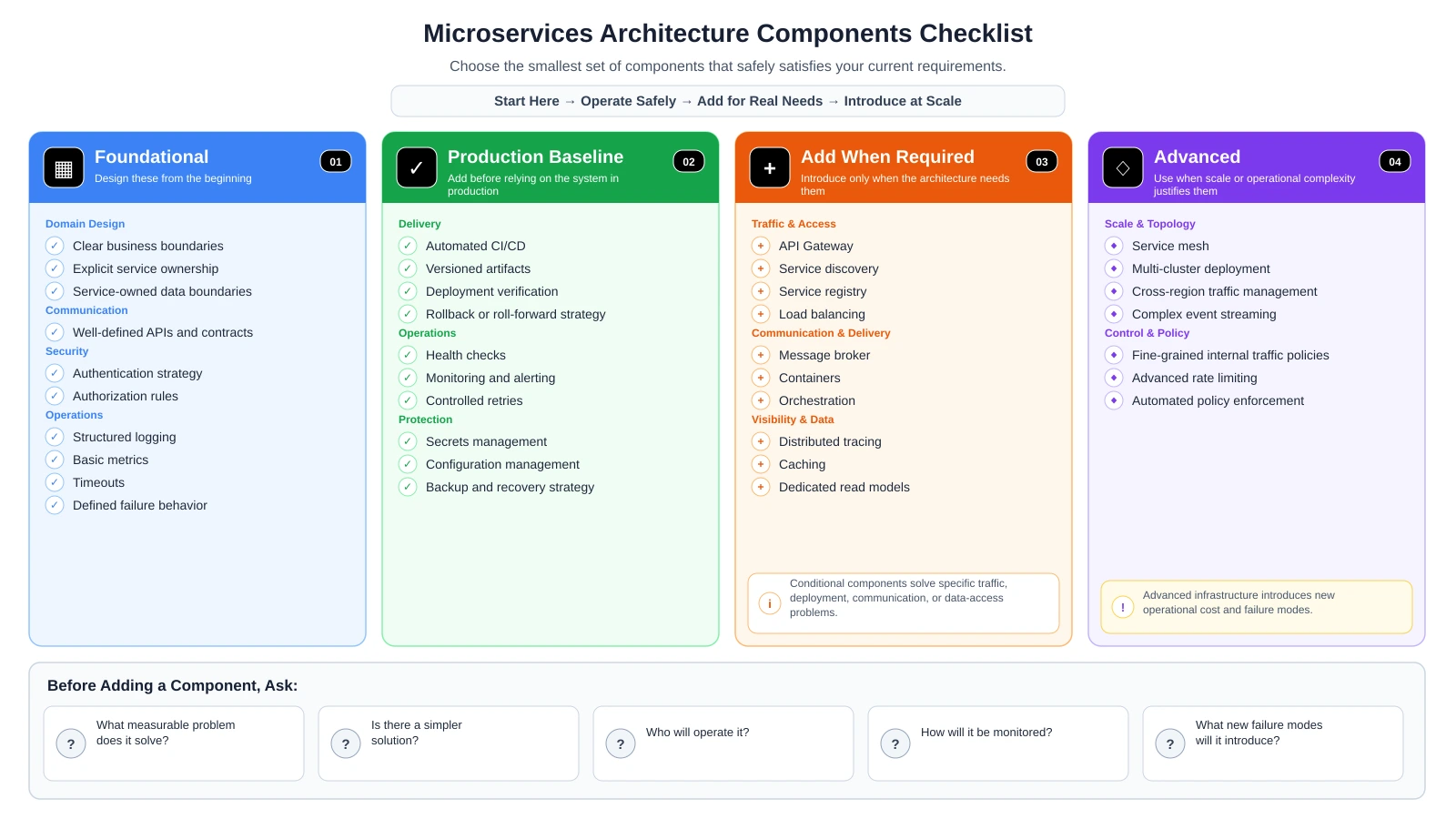
Foundational
- Clear business boundaries
- Explicit service ownership
- Well-defined APIs and contracts
- Service-owned data boundaries
- Authentication strategy
- Authorization rules
- Structured logging
- Basic metrics
- Timeouts
- Defined failure behavior
Production Baseline
- Automated CI/CD
- Health checks
- Secrets management
- Configuration management
- Monitoring and alerting
- Controlled retries
- Backup and recovery strategy
- Versioned artifacts
- Deployment verification
- Rollback or roll-forward strategy
Add When Required
- API Gateway
- Service discovery
- Service registry
- Load balancing
- Message broker
- Containers
- Orchestration
- Distributed tracing
- Caching
- Dedicated read models
Advanced
- Service mesh
- Multi-cluster deployment
- Cross-region traffic management
- Complex event streaming
- Fine-grained internal traffic policies
- Advanced rate limiting
- Automated policy enforcement
Frequently Asked Questions
What Are the Main Components of Microservices Architecture?
The main components are independent services, APIs and contracts, an entry layer, service discovery, a service registry, load balancing, service-owned data, asynchronous messaging, a service mesh where needed, security, observability, configuration management, deployment infrastructure, CI/CD, and resilience mechanisms.
The exact combination depends on the system’s size, traffic, deployment environment, and operational requirements.
What Is the Most Important Microservices Component?
The most important foundation is a clear service boundary.
Without clear business ownership, independently deployed services can remain tightly coupled and form a distributed monolith.
Data ownership, stable contracts, security, observability, and failure handling are also essential.
Is an API Gateway Required in Microservices?
No.
An API Gateway is useful when multiple external clients need controlled access to several backend services. A smaller system may use an ingress controller, reverse proxy, backend-for-frontend, or platform-managed routing layer.
What Is Service Discovery in Microservices?
Service discovery is the process of locating a healthy running instance of a service.
It becomes important when instances restart, move, scale dynamically, or receive changing network addresses.
What Is the Difference Between Service Discovery and a Service Registry?
A service registry stores or exposes information about available service instances.
Service discovery is the process of using that information to locate an appropriate instance.
Some platforms provide both capabilities automatically.
Should Every Microservice Have Its Own Database?
Each service should generally own and control its data boundary, but that does not always require a separate physical database server.
Isolation may use separate databases, schemas, collections, or other controlled storage boundaries.
The essential rule is that one service should not freely modify another service’s private data.
Why Do Microservices Use Message Brokers?
Message brokers allow services to communicate asynchronously.
A producer publishes an event or message, and consumers process it independently without requiring the producer to call each consumer directly.
Reliable messaging still requires idempotency, retries, dead-letter handling, schema management, monitoring, and duplicate-message handling.
Is a Service Mesh Required for Microservices?
No.
A service mesh is an advanced infrastructure component. It may become useful when internal traffic, identity, security policies, observability, and routing are difficult to manage consistently.
Do Microservices Require Docker or Kubernetes?
No.
Microservices can run without Docker or Kubernetes.
Containers and orchestration are operational tools. They can simplify packaging, deployment, scaling, and recovery, but they do not define service boundaries or business architecture.
What Components Are Normally Required for Production?
A production microservices system normally needs:
- Clear service ownership
- Stable communication contracts
- Security controls
- Logs and metrics
- Health checks
- Configuration and secrets management
- Automated testing and deployment
- Timeouts and controlled retries
- Backup and recovery
- An appropriate routing strategy
Components such as an API Gateway, discovery system, message broker, orchestration platform, or service mesh depend on the system’s requirements.
What Is the Difference Between an API Gateway and a Service Mesh?
An API Gateway primarily manages traffic entering the application from external clients, often called north-south traffic.
A service mesh primarily manages communication between internal services, often called east-west traffic.
They solve different problems and may be used together.
Are All Microservices Components Required From the Beginning?
No.
Begin with clear boundaries, stable contracts, data ownership, security, basic observability, automated delivery, and defined failure behavior.
Introduce additional infrastructure only when it solves a real requirement.
Conclusion
Microservices architecture is more than a collection of small applications.
It is a distributed system composed of independently owned services and the supporting components required to operate them safely.
The foundation should include:
- Clear business boundaries
- Explicit ownership
- Stable communication contracts
- Service-owned data
- Security
- Observability
- Basic resilience
- Repeatable deployment
Additional components such as an API Gateway, service discovery, message brokers, containers, orchestration, distributed tracing, and a service mesh should be introduced when the architecture genuinely requires them.
The best microservices architecture is not the one containing the most tools.
It is the one that satisfies its business and technical requirements without creating unnecessary operational complexity.
For a visual explanation of how these components connect, read Microservices Architecture Diagram Explained + Examples.
For a comparison of architecture approaches, read Microservices vs Monolithic: Pros, Cons & Differences.